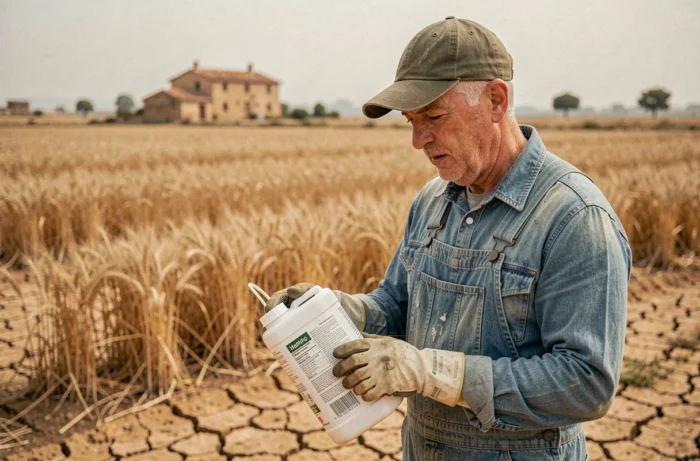
Roundup Ultra Plus remains a plant protection product available over the counter in several European countries, while France has banned its sale to individuals. Spain is among the member states where this glyphosate-based herbicide retains an active authorization, which fuels a cross-border flow of products sometimes acquired in complete ignorance of the applicable legal framework.
Roundup Ultra Plus in Spain: a registered and still valid product
Roundup Ultra Plus is registered in the Registro de Productos Fitosanitarios of the Ministerio de Agricultura, Pesca y Alimentación (MAPA) under the registration number ES-00725, with a “vigente” (valid) status. This registration implies a comprehensive evaluation covering the product’s effectiveness, health risks, and environmental impact, according to the requirements of European regulation (EC) No. 1107/2009.
The formulation corresponds to a soluble concentrate (SL) dosed at 36% glyphosate in the form of potassium salt. At this concentration, it is a non-selective systemic herbicide capable of destroying nearly all treated plants.
The purchase and use are reserved for professionals holding a competence certification obtained after training. A Spanish individual cannot, in principle, acquire this product without presenting this proof to an agricultural cooperative or a specialized distributor.
To learn more about the regulation of Roundup Ultra Plus in Spain, several resources detail the required documents and purchasing conditions. Controls at points of sale vary by region and brand, creating a gap between the legal framework and what is practiced on the ground.
Glyphosate and health: two scientific readings that coexist
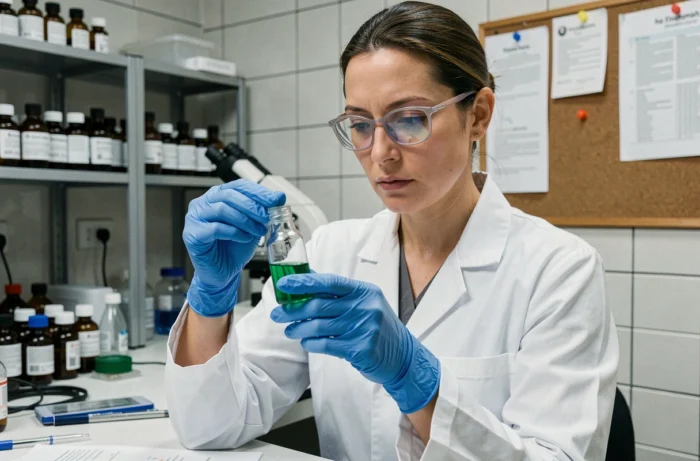
The health debate surrounding glyphosate opposes two institutional positions. The International Agency for Research on Cancer (IARC, affiliated with WHO) has classified the substance in Group 2A of its classification. The European Food Safety Authority (EFSA), on the other hand, concluded during the approval renewal process at the end of 2023 that the available data did not allow glyphosate to be classified as carcinogenic according to European regulatory criteria.
This divergence has direct consequences on the product’s market presence. The approval of the active substance was renewed at the end of 2023 for a limited duration, which maintains the legal basis for formulated products like Roundup Ultra Plus.
The available data do not allow for conclusions about genotoxicity at low doses over the long term. Epidemiological studies primarily focus on occupational populations exposed repeatedly, and their transposition to occasional users is still a subject of discussion in the scientific literature.
Risks associated with co-formulants
Roundup Ultra Plus is not just glyphosate. The co-formulants added to improve foliar penetration (surfactants, wetting agents) may have their own toxicity, sometimes exceeding that of the isolated active substance. Regulatory assessments focus on the formulated product as a whole, but interactions between components over the long term remain an open research field.
Importing Roundup Ultra Plus into France: what the law says
The Labbé law and its successive reinforcements prohibit the sale of plant protection products containing glyphosate to individuals in France. Bringing back Roundup Ultra Plus purchased in Spain for domestic use on French territory constitutes an offense.
- A product authorized in Spain is not automatically authorized in France: each member state issues its own market authorizations, even when the active substance has European approval.
- The importation of unapproved plant protection products into France exposes individuals to criminal prosecution, with penalties that may include significant fines and the seizure of products.
Alternatives to glyphosate for French individuals
Deprived of access to chemical herbicides, individuals in France have several solutions. Their effectiveness remains lower than that of glyphosate on certain types of vegetation, which partly explains the temptation for cross-border purchases.
Mechanical weeding (hoeing, hand weeding, rototiller) remains the most common method. Biocontrol products based on pelargonic acid or concentrated acetic acid act by contact: they burn the aerial parts without reaching the roots. Therefore, repeated applications are necessary.
Agronomic approaches (mulching, false seeding, cover crops) are more relevant to agricultural areas or large gardens. Their implementation represents a time investment far greater than that of applying chemical herbicides.
Biocontrol products and non-agricultural areas
In non-agricultural areas (sidewalks, driveways, public green spaces), French regulations require the exclusive use of alternative methods. Some products based on pelargonic acid carry the label “authorized for use in gardens” (EAJ), making them accessible in garden centers.
No biocontrol herbicide replicates the systemic action of glyphosate, which migrates to the roots to destroy the entire plant. This difference in effectiveness remains the main reason gardeners seek glyphosate beyond French borders.
The European regulatory framework will undergo a new review at the expiration of the renewed approval at the end of 2023. French authorities are now treating the phenomenon of illegal importation as a public health issue as much as a plant health enforcement matter.