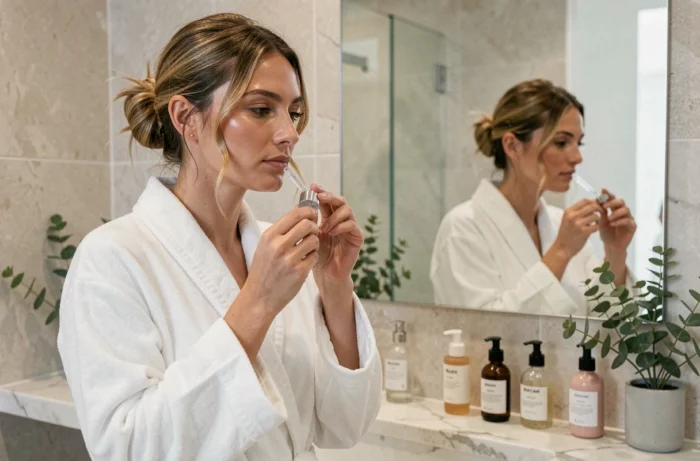
Your favorite day cream displays the “clean beauty” label on its packaging. But do you know that this term currently has no harmonized regulatory definition in Europe? Beauty and skincare trends are evolving quickly, and regulations are starting to catch up with marketing. Understanding what is really changing allows for more relevant choices for your skin and daily routine.
Green claims in cosmetics: what the European directive changes starting September 2026
Competitors rarely talk about regulations. Yet, this is the topic that will most disrupt the labels of your beauty products in the coming months.
The European directive 2024/825, known as ECGT (Empowering Consumers for the Green Transition), applies to all B2C actors starting September 27, 2026. Generic claims like “natural,” “green,” “eco-friendly,” or “biodegradable” will be considered unfair commercial practices if the brand cannot demonstrate recognized excellent environmental performance, for example, through the EU Ecolabel.
Claims of “carbon neutral” based solely on the purchase of external carbon credits are also prohibited. Only reductions in emissions within the product’s own value chain remain acceptable, provided they can be demonstrated throughout the entire lifecycle.
In-house labels (those little green logos invented by the brands themselves) must correspond to an official certification system or one recognized by an independent third party. Massive reformulations of packaging and slogans can be expected before this date. To keep track of these developments and identify products with verifiable commitments, specialized resources like planete-beaute.com allow for comparisons of face and body care based on concrete criteria.
Minimalist skincare routine: fewer products, more targeted actives
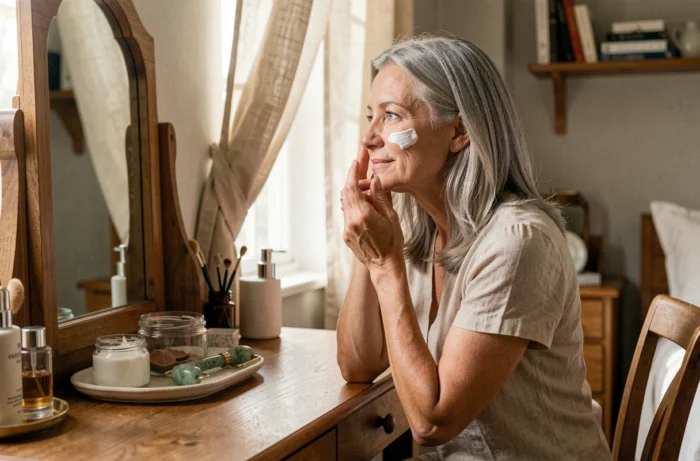
Have you noticed that your bathroom is overflowing with half-empty bottles? The skinimalism trend is based on a simple idea: reduce the number of products to keep only those that truly work. Three to four well-chosen products replace a dozen layers applied every morning.
This approach requires knowing the actual needs of your skin. A hyaluronic acid serum and a moisturizer are often enough for normal skin. Skin prone to imperfections will benefit more from a gentle cleanser combined with a treatment containing niacinamide.
How to identify the actives that matter
Rather than multiplying references, focus on the INCI list (the composition on the back of the product). Actives listed among the first five ingredients are present in significant quantities. Those relegated to the end of the list often serve only a marketing purpose.
- Hyaluronic acid retains water in the upper layers of the epidermis and is suitable for most skin types, including sensitive skin.
- Niacinamide (vitamin B3) regulates sebum production and reduces redness. It combines well with most other actives.
- Natural alternatives to retinol, such as bakuchiol, offer anti-aging action that is better tolerated by reactive skin that cannot handle traditional retinol.
Fewer steps each morning does not mean fewer results. The rigorous selection of actives makes all the difference.
Hybrid makeup-skincare products: when foundation becomes a face treatment
The boundaries between makeup and skincare are blurring. Hybrid products incorporate skincare actives (SPF, hyaluronic acid, peptides) directly into the formulas of foundation, blush, or lip balm.
The benefits are twofold. First, it simplifies the morning routine: one product replaces two steps. Secondly, the skin receives hydrating or protective actives throughout the day, not just during the initial application of the treatment.
SPF integrated into makeup: is it sufficient protection?
The rise of SPF in makeup products responds to a concrete demand. Applying sunscreen under foundation can weigh down the skin and may lead to unpleasant textures. A foundation containing a sun filter seems more practical.
However, be cautious: the amount of product applied in makeup is generally less than what is needed to achieve the stated level of protection. A foundation with SPF 30 applied in a thin layer offers less protection than a dedicated sunscreen. Hybrid products complement sun protection; they do not replace it.
Bodycare and body treatments: the routine doesn’t stop at the face
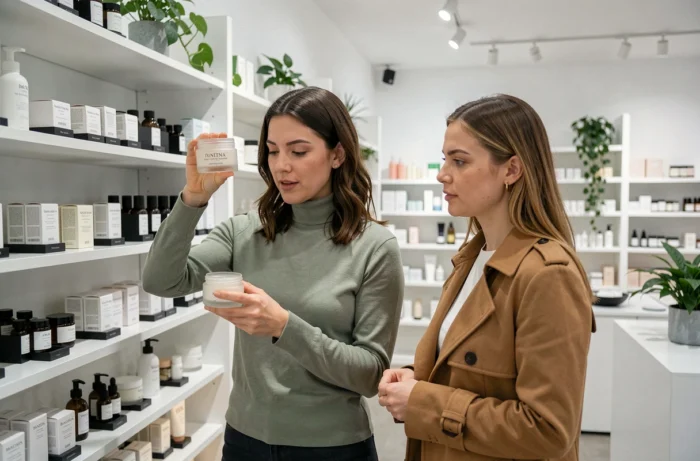
The bodycare trend, largely driven by K-Beauty, extends facial care gestures to the entire body. Gentle exfoliation, body serums, nourishing oils: the body now receives the same level of attention as the face.
Why this change? Because the skin on the body faces the same aggressions (cold, sun, hard water) without usually receiving the same care. Areas like elbows, knees, or shins are often neglected even though they dehydrate first, especially in winter.
Building an effective body routine without multiplying products
Apply a nourishing oil or balm right after the shower, on slightly damp skin. This single gesture traps moisture and visibly improves skin elasticity in just a few days. One well-applied body product at the right time is better than three products used on dry skin.
- Choose a body cleanser with a pH close to that of the skin to avoid disrupting the hydrolipidic film.
- Body exfoliation once or twice per season is sufficient for most skin types. More frequent exfoliation can weaken the skin barrier.
- Exposed areas (hands, décolleté) deserve dedicated sun protection, even outside the summer season.
This year’s beauty and skincare trends converge towards a common principle: shorter routines, better-targeted formulas, and claims soon to be regulated by law. The ECGT directive of September 2026 will push brands to prove their claims. For consumers, this is good news: choosing a face or body care product will become clearer, provided you read beyond the packaging.