
Retirement marks the end of a professional framework that structured daily life, social relationships, and often identity. Successfully navigating this transition requires replacing this framework with chosen reference points, whether related to health, finances, or engagement in community life. Resources exist, but they remain scattered among pension funds, local authorities, associations, and online platforms.
The departmental public service for autonomy, a still little-known resource
Since 2025, the departmental public service for autonomy operates as a single entry point for retirees. It coordinates assistance, contributes to the prevention of loss of autonomy, and acts against social isolation.
Its main advantage lies in its territorial logic. Instead of sequentially contacting the CARSAT, CCAS, mutual insurance, and the departmental council, retirees have a single point of contact capable of directing them to prevention workshops, home support, or administrative assistance tailored to their situation.
In addition to this institutional approach, some specialized portals facilitate access to practical information about life after a career. seniors-univers.fr, for example, gathers content on leisure, budget management, and health issues, avoiding the need to navigate through a dozen different sites.

Retirement income: the most common management errors
A pension is not a fixed amount. It evolves with annual adjustments, social contributions, and the household’s tax regime. However, many retirees stop monitoring these parameters once their rights are liquidated.
Discrepancy between estimation and actual amount received
Before retirement, the estimation is based on assumptions: last salaries, validated quarters, age of cessation of activity. Once retirement is effective, the net amount often comes as a surprise. The CSG and the complementary health insurance deducted at source widen the gap with the initial projection.
Checking one’s career statement before and after liquidation remains the most effective precaution. There are errors in the reporting of quarters that can be corrected more easily in the first years following retirement.
Taxation and supplementary income
Retirement savings plans, rental income, and activity in a combined employment-retirement scheme: each of these streams alters the tax bracket. Managing them separately can lead to surprises. A retiree who resumes part-time work without recalculating their withholding tax rate risks a hefty adjustment the following year.
Health prevention: what pension funds concretely offer
Pension funds (CARSAT, MSA, CNRACL depending on the scheme) finance free or symbolically priced health prevention workshops. Balance and fall prevention, memory stimulation, nutrition, sleep management: the topics cover the most common issues after 60 years old.
Registration goes through the fund to which the retiree belongs. This system explains why many are unaware of these programs: information does not always arrive spontaneously.
- Memory programs do not only target individuals with cognitive disorders. They also serve to maintain intellectual stimulation after ceasing professional activity.
Sports assistance for seniors does not rely on a single national scheme. It consists of aids scattered among pension funds, mutual insurance, local authorities, and sports associations. Identifying available support often requires contacting each organization separately.
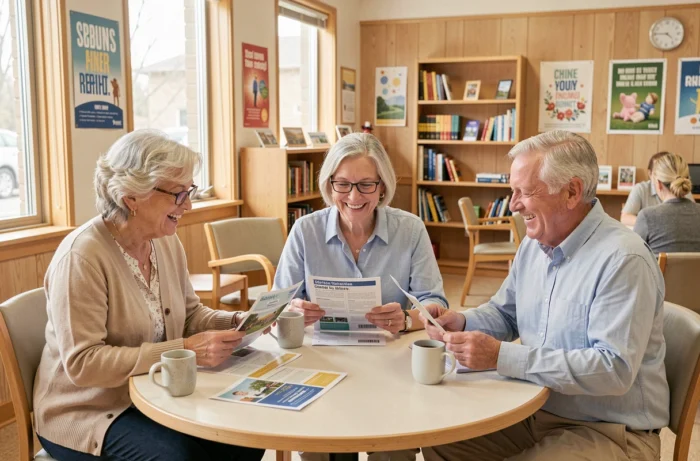
Social life and engagement: building a network after retirement
The loss of the professional network remains one of the most underestimated factors of isolation in retirement. Re-establishing connections requires an active approach, especially for those whose social life was centered around work.
Volunteering is the best-documented lever. Platforms like JeVeuxAider.gouv.fr and local branches of major associations (Restos du Cœur, Secours populaire, petits frères des Pauvres) offer occasional or regular missions, tailored to individual availability.
Universities of leisure and collective workshops in town halls or community centers provide a structured environment for those who prefer to learn. Languages, IT, local history, visual arts: the catalog varies by municipality, but most medium-sized cities have at least one such structure.
- Affiliated sports clubs sometimes offer slots reserved for retirees, with reduced fees.
- Shared gardens, managed by neighborhood associations, combine moderate physical activity, food production, and local social connections.
- Public digital spaces (media libraries, community houses) organize free introductory workshops on digital skills, helping to reduce the digital divide while creating opportunities for social interaction.
A decree published on July 15, 2025, also opens new possibilities for progressive retirement, allowing individuals to reduce their working hours while receiving part of their pension. This type of scheme can serve as a gentle transition for those who do not wish to abruptly cut ties with active life.
Regular monitoring of one’s pension, one or two prevention workshops per year, and chosen social engagement are sufficient to maintain a balanced daily life. Structuring retirement around a few concrete pillars yields more sustainable results than trying to cover everything. The challenge is not finding resources, but sorting through the existing ones.