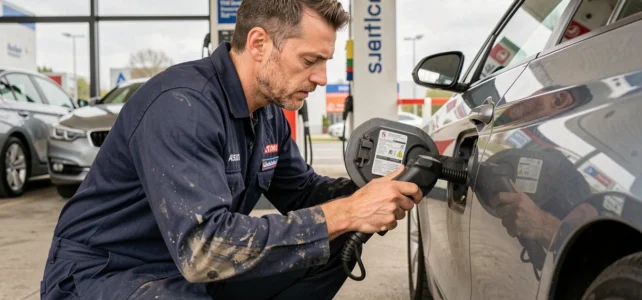
The E25 fuel refers to a blend of gasoline and ethanol where the alcohol content reaches 25%. On the fuel flaps of many recent BMW models, the mention of E25 appears alongside E5 and E10, which raises legitimate questions among owners. However, this displayed compatibility does not correspond to any fuel available at pumps in Europe, and it is precisely this discrepancy that fuels the confusion.
BMW Modular Engines and E25 Validation: What the Manufacturer Says
BMW has confirmed in writing that all its modular family engines (B38, B48, B58 and derivatives) are internally validated to operate with an ethanol content of up to 25%. This validation dates back to early 2019 and applies globally.
The reason is simple. The European standard EN228, which governs the composition of gasoline distributed in the European Union, limits the ethanol content to 10%. In Brazil or in some Southeast Asian countries, high-ethanol fuels are common. BMW designs its engines to withstand these blends, even though the majority of European drivers will never encounter them at the pump.
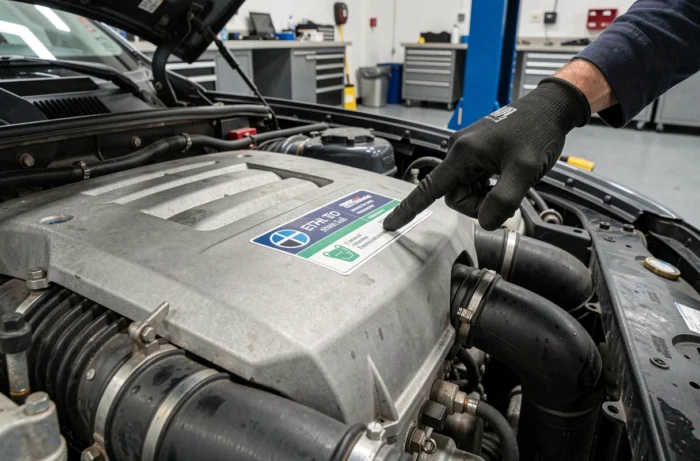
Misconceptions about E25 fuel for BMW circulate widely on forums, where owners sometimes confuse E25 with E85 or fear damaging their engine by using E10. The mention on the flap means that the engine tolerates up to 25% ethanol, not that it should be sought out.
E5, E10, E25, E85: Differences in Composition and Effects on the Engine
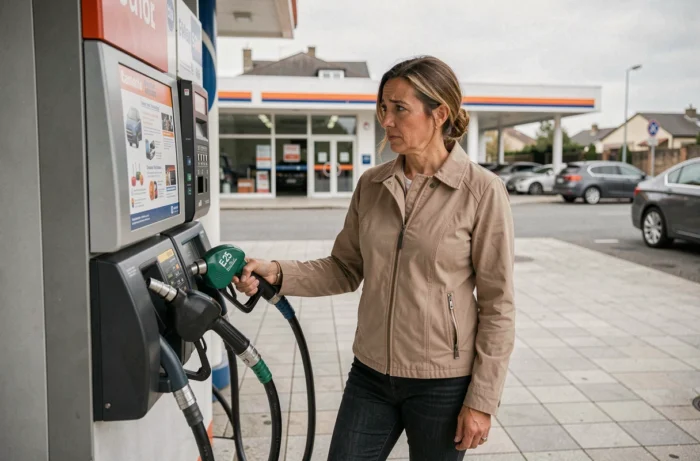
The number after the “E” indicates the maximum percentage of ethanol in the blend. E5 contains up to 5% ethanol, E10 up to 10%, E25 up to 25%, and E85 ranges between 65% and 85% depending on the season.
Ethanol has a lower calorific value than gasoline. In practical terms, one liter of ethanol releases less energy than one liter of pure gasoline. The higher the proportion of ethanol, the greater the volumetric consumption to cover the same distance.
A BMW 218i owner reported on a specialized forum that they tested a high-ethanol blend in another vehicle, noting a significant increase in consumption. In a BMW modular engine, the electronic management adjusts the air-fuel mixture in real-time, which limits jolts, but does not eliminate the overconsumption related to the lower energy density of ethanol.
The Issue of Corrosion of Components
Ethanol is hygroscopic: it absorbs ambient moisture. At high concentrations, this property accelerates the corrosion of seals, hoses, and tanks not designed to withstand it. BMW engines validated for E25 use compatible materials (Viton seals, adapted fuel circuits).
An engine not validated for E25 should never receive fuel exceeding the standard indicated on its flap. For BMWs prior to the modular family, the limit remains E10, unless otherwise stated in the maintenance booklet.
Why E25 Does Not Exist at Gas Stations in Europe
The EN228 standard constitutes the regulatory framework for gasoline sold in the European Union. It sets a cap of 10% ethanol. No European gas station sells E25 at retail.
Some pilot tests with E15 have been reported, particularly in Germany, but they remain marginal. Transitioning to an E20 or E25 fuel would require:
- A revision of the EN228 standard, which imposes lengthy legislative procedures at the European Union level
- An adaptation of the pump and tank infrastructure in gas stations, with significant infrastructure costs
- A guarantee of compatibility for the entire vehicle fleet in circulation, not just recent vehicles
BMW has never actively communicated in Europe about the E25 compatibility of its engines. The manufacturer considers this information to be part of the global market and not directly relevant to European drivers, due to the lack of available fuel.
E25 Fuel and BMW: The Three Most Common Confusions
Confusing E25 and E85
E85, also known as superethanol, contains between 65% and 85% ethanol. No standard BMW engine is approved for E85 without specific conversion (flex-fuel kit). Putting E85 in a tank designed for a maximum of E25 exposes the engine to damage to the injectors, valves, and fuel system.
Believing that E10 damages an E25 compatible engine
If a BMW engine is validated for up to 25% ethanol, E10 represents a blend well below its tolerance. SP95-E10, the best-selling fuel in France, is perfectly suited for these engines. The safety margin is wide.
Thinking that the E25 mention requires seeking out this fuel
The mention on the fuel flap indicates a high limit, not a recommendation. In Europe, SP95 (E5) and SP95-E10 remain the reference fuels for all recent gasoline BMWs.
The E25 compatibility of BMW modular engines is a documented technical reality by the manufacturer, but it does not change refueling habits in Europe. E25 fuel is not distributed there, and E10 remains the standard choice. For owners of BMWs equipped with B38, B48, or B58 engines, the only concrete precaution is to check the mention on the flap and adhere to the indicated limit, without exceeding it.