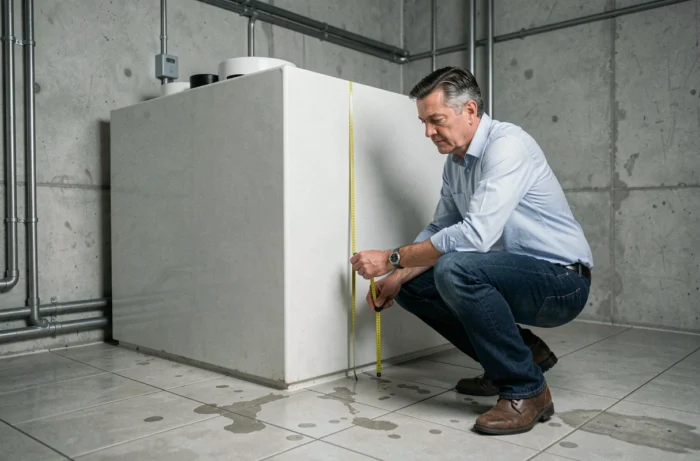
Converting square meters to liters is a common request, but it is based on a persistent confusion. A square meter measures an area, while a liter measures a volume. Without height or depth, no conversion is possible. This distinction, often overlooked in online guides, is the key to any reliable calculation.
Why square meters do not directly give a volume in liters
The confusion between area and volume is one of the most common mistakes in domestic and professional usage. It typically arises when one knows the area of the bottom of a pool, a tank, or a room, and attempts to deduce a capacity in liters without measuring the depth.
The square meter (m²) describes a two-dimensional space: length and width. The liter, on the other hand, derives from the cubic meter (m³), which adds a third dimension. 1 m³ equals 1,000 liters. Therefore, to obtain a volume, one must always multiply the area by a height expressed in meters, and then convert the result.
To calculate the volume in liters, the process follows a precise sequence: area (m²) x height (m) = volume (m³), then volume (m³) x 1,000 = volume in liters. Skipping the height step amounts to comparing incompatible quantities.

Calculating volume in liters: step-by-step method with height
Let’s take a concrete example. You know the floor area of a rectangular basin and its depth. The formula is straightforward.
Rectangular or square area
Multiply the length by the width to obtain the area in m². Then multiply this area by the height (or depth) in meters. The result is in m³. To convert to liters, multiply by 1,000.
Example: a tank that is 2 m long, 1.5 m wide, and 1 m deep gives 2 x 1.5 x 1 = 3 m³, or 3,000 liters.
Circular area (cylinder)
For a round basin or a cylindrical tank, the area is calculated using the formula π x radius². Then multiply by the height to obtain the volume in m³, and then by 1,000 for liters.
A cylindrical reservoir with a bottom radius of 0.5 m and a height of 2 m gives: π x 0.5² x 2 = approximately 1.57 m³, or about 1,570 liters.
Irregular shapes
When the shape of the bottom is neither rectangular nor circular (bean-shaped pool, trapezoidal tank), break the surface down into simple shapes, calculate each sub-volume separately, and then add them together. This decomposition approach remains the most reliable without specialized tools.
Common mistakes in converting m² to liters
Conversion guides focus on formulas, but actual errors rarely occur at the multiplication by 1,000 stage. They arise upstream.
- Forgetting to convert centimeters to meters before the calculation. A height of 80 cm must be entered as 0.8 m; otherwise, the result is significantly skewed.
- Confusing the total surface area of an object (all its faces) with the area of its base. Only the base area, multiplied by the height, gives the interior volume.
- Neglecting variations in depth. A pool with a depth varying from 1 m to 2 m cannot be calculated with a single value: one must use the average depth or break the basin down into sections.
- Using mixed units without realizing it, for example, a length in meters and a width in centimeters in the same multiplication.
The primary source of error is the combination of incorrect units and missing height, not the formula itself. Checking the consistency of units before any calculation eliminates the majority of erroneous results.
Quick conversion table: m³ to liters
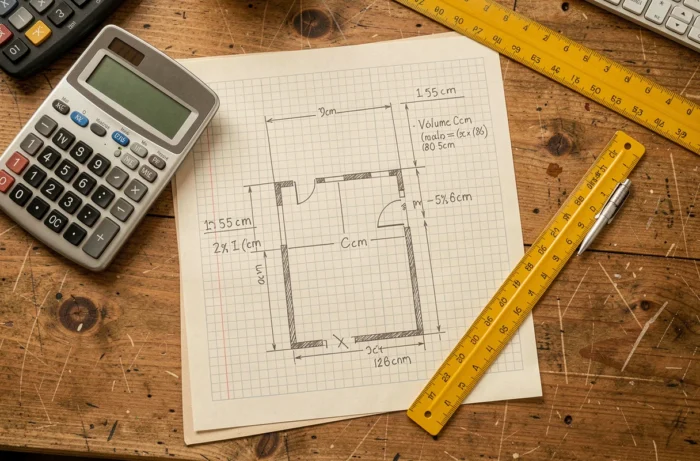
Once the volume is obtained in cubic meters, the conversion to liters is mechanical. This table covers the most common cases in a domestic or semi-professional context.
| Volume in m³ | Volume in liters |
|---|---|
| 0.001 | 1 |
| 0.01 | 10 |
| 0.1 | 100 |
| 0.5 | 500 |
| 1 | 1,000 |
| 5 | 5,000 |
| 10 | 10,000 |
The logic is constant: move the decimal point three places to the right to convert from m³ to liters, or to the left for the reverse operation.
Practical cases where area alone is not enough
In excavation quotes or water bills, volumes are often expressed in m³. On a house plan or a pool description, the area in m² is indicated. The transition from one to the other always requires an additional piece of data: height, depth, or thickness.
For a concrete slab, for example, the floor area is known, but the thickness (often a few centimeters) determines the volume of material needed. Even a thickness of a few centimeters radically changes the total volume once the area exceeds a few m².
For filling a pool, the average depth allows for estimating the amount of water. Field feedback varies on this point: some installers use the median depth, while others break the basin down into slices. The latter method yields a result closer to reality when the bottom is not flat.
The reflex to remember remains the same in all cases. Any area expressed in m² needs a third dimension to become a volume. Without this measurement, the calculation has no physical meaning, and the result in liters will necessarily be incorrect.