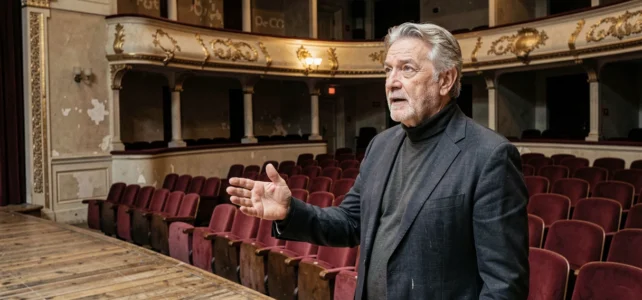
Francis Azéma is an actor, director, artistic director, and educator. Since the early 1990s, his work has shaped a part of the theatrical life in Toulouse, from the stage to the classroom, including the programming of a venue that has become a landmark for regional companies: the Théâtre du Pavé, in the Saint-Agne neighborhood.
Le Grenier Théâtre and the company les Vagabonds: two founding pillars
Before directing a theater, Francis Azéma founded the Grenier Théâtre, a creation structure that allowed him to lay the foundations of his scenic approach. The principle has remained the same since: to work on the texts of the classical and contemporary repertoire with a stable troupe, rather than multiplying occasional collaborations.
In 1994, he created the company les Vagabonds, which became his main tool for staging and interpretation. The repertoire includes works from Sophocles to Ionesco, La Fontaine to Racine. This company remains resident at the Théâtre du Pavé and produces most of the venue’s so-called “in-house” creations.
Those who wish to meet Francis Azema in Toulouse will find a constant in these creations: a commitment to the text as the primary material, before scenography or effects.
Théâtre du Pavé in Toulouse: a place shaped by its director
In 2001, Paul Berger entrusted the artistic direction of the Théâtre du Pavé to Francis Azéma. The venue has existed for much longer. Formerly an annex of the Saint-Agne church, then a neighborhood cinema, it has gone through several lives before becoming a theater.
The auditorium has about two hundred seats. A bar area with around fifty seats hosts exhibitions and meetings after performances. This modest format is not a handicap: it defines the identity of the Pavé, a community theater open to regional companies.
Under Azéma’s direction, the venue is not limited to the productions of les Vagabonds. The programming expands to other disciplines and associations:
- “Un pavé dans le jazz,” an association led by Jean-Pierre Layrac, programs current jazz concerts and is part of the Federation of Jazz and Improvised Music Scenes.
- “Les p’tits cailloux,” under the direction of Corinne Mariotto, offers performances for young audiences and the general public during school holidays.
- The festival “Le temps des cerises” mixes poetry, song, music, and other forms of expression over several days.
This openness to other artistic forms transforms the Pavé into a multidisciplinary space, even though text-based theater remains the heart of the programming.
Theatrical education in Toulouse: the Azéma method
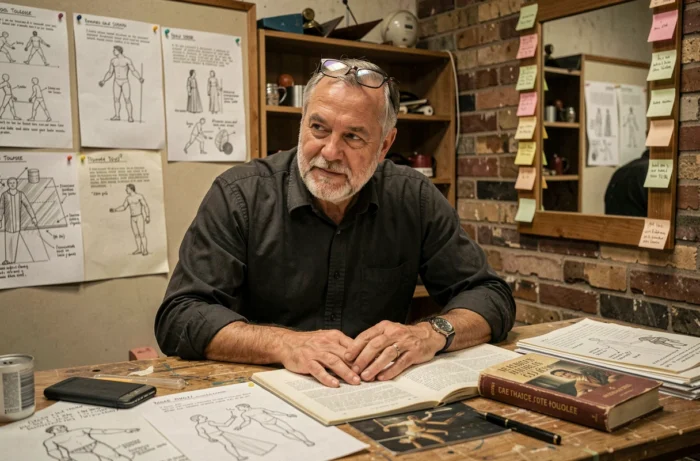
Francis Azéma has been teaching at the Conservatoire National de Région de Toulouse since 1989. This pedagogical work is not limited to the public institution. He has successively created several training structures: the school le Passage à Niveau, the Graines d’acteur workshops, and then the Atelier du Misanthrope.
Each structure addresses a different level or objective. The Atelier du Misanthrope, launched in 2009, welcomes actors who want to deepen their work on the classical repertoire. The Graines d’acteur workshops cater to a broader audience, including beginners.
This layering of educational frameworks creates a unique local network. A budding actor from Toulouse can move from the Conservatoire to a workshop led by the same practitioner, with a consistency of method rarely available in a city of this size.
The link between teaching and creation is direct. The productions at the Pavé function as a theatrical laboratory for young actors trained in these workshops. Some join the company les Vagabonds, while others launch their own projects relying on the network built around the venue.
Transition at the Théâtre du Pavé: what changes after Azéma
An article published by Culture31 in September 2024 announces that a new chapter is beginning at the Théâtre du Pavé. After more than two decades under Azéma’s leadership, a new artistic team is taking over with the intention of redefining the programming line.
The announced repositioning aims to transform the Pavé into an “artists’ house,” a model that emphasizes creation residencies and collaboration between companies, rather than the figure of a single director who programs, directs, and performs.
This change does not diminish Azéma’s impact on the venue. The repertoire he defended, the companies he hosted, and the actors he trained constitute a concrete legacy. The question is how the Pavé will maintain its identity as a text-based theater while expanding its modes of operation.
Francis Azéma’s journey illustrates what can result from an artist’s rooting in a territory over several decades: an identifiable place, generations of actors trained under a common approach, and a text-based theater that remains accessible without being simplistic. The transition at the Pavé will, in this respect, be a real-world test for the sustainability of this model in Toulouse.