What criteria truly distinguish an exceptional garden from a simply well-maintained green space? Between the official label from the Ministry of Culture, the climatic constraints that reshape plant palettes, and the increasingly resilience-oriented botanical choices, the very notion of an exceptional garden is evolving. This article measures the gaps between labeled gardens and remarkable gardens without a label, and examines how climate change is reshuffling the cards of French botanical heritage.
Remarkable Garden Label: Official Criteria and Access Constraints
The Remarkable Garden label, created in 2004 by the Ministry of Culture, remains the main institutional marker for qualifying an exceptional garden in France. Its attribution is based on a decision by the regional prefect, for a renewable period of five years.
The requirements are not limited to the beauty of the place. A candidate garden must guarantee a public opening of at least 40 days per year and 6 hours per day. This threshold effectively excludes private gardens that only welcome visitors occasionally.
| Criterion | Labeled “Remarkable” Garden | Exceptional Garden without Label |
|---|---|---|
| Official Attribution | Regional Prefect, based on application | No institutional recognition |
| Label Duration | 5 years renewable | Not applicable |
| Public Opening | Minimum 40 days/year, 6 h/day | Variable, often by appointment |
| Commercial Purpose | Excluded by specifications | Free |
| Documented Maintenance | Management plan required | At the owner’s discretion |
This strict framework explains why some high-quality botanical or private gardens do not appear on the official list. The absence of a label does not mean a lack of interest, but rather a lack of public guarantee regarding the sustainability of maintenance and access.
For those wishing to discover a landscaped space combining plant art and personalized welcome, it is possible to learn more about Le Jardin D’Helena, a place that illustrates this approach to visitor openness.
Heritage Gardens Facing Climate Change: Recent Data
The French garden model, with its boxwood embroidery and manicured lawns, is under direct pressure from global warming. An article from Le Monde dated September 3, 2026, documents this fragility in major historical estates.
In Chambord, horticultural teams are facing repeated drought episodes that threaten the survival of certain traditional species. Successive heatwaves force gardens to change their appearance, according to terms echoed by Euronews in August 2026.
The Ministry of Culture published a guide in spring 2026 titled Composing with Climate Change in a Heritage Garden. Its recommendations focus on three axes:
- Review soil management to improve water retention, by reducing superficial mechanical work that accelerates evaporation
- Reduce mowing frequency to preserve residual moisture and promote soil biodiversity
- Rethink plant layers by integrating species adapted to prolonged heat episodes
These recommendations mark a turning point. A labeled heritage garden must now reconcile historical fidelity with botanical adaptation, two objectives that can sometimes be contradictory.
Xerophytic Plants and Resilient Botanical Choices in Exceptional Gardens
Plant selection is the main lever for adaptation. In Chambord, gardeners are directing their plantings towards xerophytic plants, capable of surviving with very little water. This choice is not trivial in a domain historically associated with classical flowerbeds.
In Guadeloupe, a remarkable garden has taken this logic to its conclusion by housing a collection of cacti and succulents, transforming the tropical climatic constraint into a landscape identity. In Réunion, the Mascarin botanical garden renewed its national label by betting on an endemic plant palette.
These examples illustrate a trend: botanical exception is now measured by the capacity for adaptation, not just by the rarity of species. A garden that integrates Mediterranean plants in a historically temperate region does not betray its history. It extends it in the face of conditions its creators had not anticipated.
Remarkable Gardens in the Region: Geographic Diversity and New Labeling
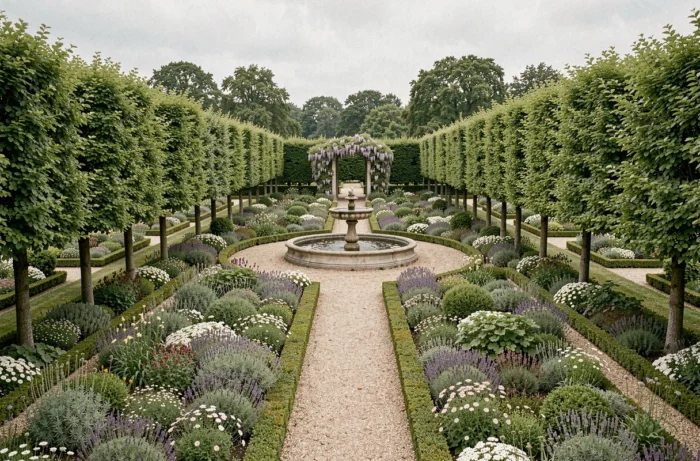
In Auvergne-Rhône-Alpes, seven new gardens have recently obtained the Remarkable Garden label. The Jardin des Cimes, in Passy in Haute-Savoie, spans three hectares at over a thousand meters altitude, facing the Mont-Blanc massif. Its case illustrates the geographic diversity of labeling: an exceptional garden is not limited to the Loire or Île-de-France.
This territorial distribution responds to the Ministry of Culture’s desire to promote botanical heritage beyond the grand aristocratic estates. Mountain gardens, overseas tropical gardens, and Mediterranean gardens now coexist under the same label.
However, this diversity complicates comparisons between sites. An altitude garden in Passy and a tropical botanical garden in Guadeloupe do not share the same climatic constraints, maintenance costs, or audience. The label unifies a designation without harmonizing the realities on the ground.
Inspiration for Creating a Sustainable Landscaped Space
Transposing the spirit of an exceptional garden into a private space requires prioritizing choices. Three principles derived from the practices of labeled gardens deserve to be retained:
- Favor species adapted to the local climate over decorative varieties that are water-intensive, even if they are more spectacular in the short term
- Structure the garden in layers (ground cover, shrubs, trees) to limit evaporation and create protective microclimates
- Document a minimal management plan, even informal, to anticipate seasonal maintenance and avoid costly corrective interventions
The approach of heritage gardens facing drought shows that sustainability is becoming a criterion of prestige, not a concession. A private garden designed with this logic gains botanical coherence in the long term.
The ministerial guide published in 2026 on the climate adaptation of heritage gardens confirms this direction: practices that preserve soil and water resources are no longer secondary options. They define what will distinguish, in the coming decades, an exceptional garden from a simply decorative garden.