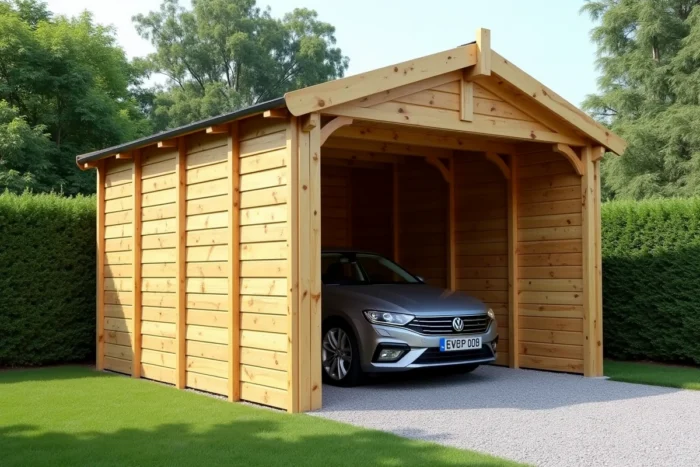
A neighbor building his carport on a Saturday morning is the kind of scene that makes you want to get started. Except that between the kit delivered on a pallet and the structure standing up, there is a gap that the catalog price does not show. Buying a wooden carport for your garden without blowing the budget requires looking in the right place, and above all, understanding what drives up the bill beyond the kit itself.
Foundations and ground preparation: the real budget item for a wooden carport
We often talk about the price of the carport, rarely about what is underneath. The slab or ground support represents a significant portion of the total cost, sometimes as much as the kit itself. A sloping site, clay soil, or difficult access for delivery completely changes the equation.
For a simple wooden carport, three foundation options frequently come up:
- Individual concrete footings, suitable for stable ground and lightweight structures, with a lower material cost but requiring precise leveling work.
- The poured concrete slab, more expensive in materials and time, but providing a solid base for double carports or flat-roofed models receiving snow loads.
- Adjustable supports screwed into footings, a compromise that simplifies the kit assembly and tolerates slight irregularities in the ground.
The ground support determines the lifespan of the entire structure. A wooden post placed directly on damp ground without a footing or metal anchoring will rot in a few seasons. Feedback varies on this point depending on regions and exposure, but the principle remains the same: isolate the wood from direct contact with the earth.
When looking to buy a cheap wooden carport from Brico Dépôt, this item must be included in the calculation. A kit costing a few hundred euros becomes significantly more expensive once the slab or footings are added.
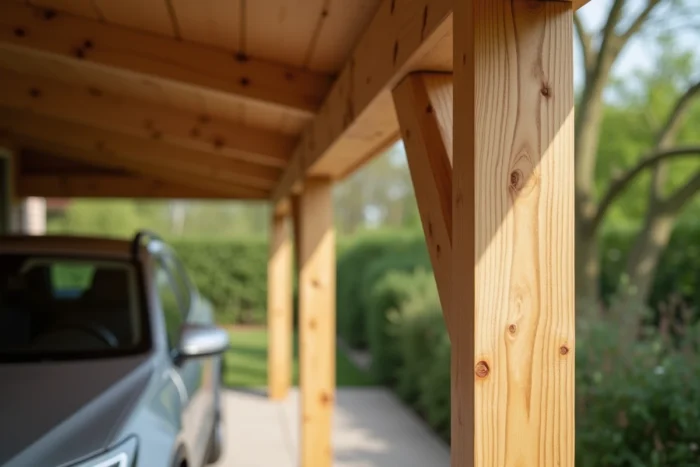
Autoclaved wood, thermally treated wood: what it changes for a garden carport
The treatment of the wood is the criterion that separates a carport that lasts ten years from one that needs replacing after four. Two sectors dominate the market for kit carports.
Class 3 or 4 autoclaved wood is pressure-treated with a fungicide and insecticide. It resists fungi and wood-eating insects without special maintenance in the first few years. This is the most common treatment for entry-level carports.
Thermally treated wood (or heat-treated) undergoes high-temperature heating that alters its cellular structure. It becomes naturally resistant to moisture, without chemical products. Its appearance is darker, often brown, and it requires neither stain nor saturator to maintain its mechanical properties.
The price difference between the two is not negligible. Thermally treated wood is more expensive to purchase but eliminates regular maintenance costs (staining every two to three years for exposed autoclaved wood). Over time, the gap narrows.
Thickness of posts and section of the frame
A low-cost carport often uses posts of reduced section. On a freestanding model exposed to wind, posts that are too thin weaken the whole structure. Check the section of the posts and load-bearing beams before comparing prices: a carport with a generously sized frame will be more stable than a cheaper model with undersized elements.
Preliminary declaration and development tax: the hidden costs of the carport
Installing a carport in your garden is not a trivial act from an administrative standpoint. For a footprint between 5 and 20 m², a preliminary declaration of works is mandatory. Beyond that, a building permit may be required, especially in protected areas or in zone N of the local urban plan.
Below 5 m², no formalities are generally required, but this area corresponds to a very small shelter, insufficient for most vehicles.
Rising development tax
The flat rates used to calculate the development tax were increased on January 1, 2026. A carport that creates taxable surface area (any covered and closed or semi-closed structure) generates an additional amount on your tax notice. This cost is often overlooked in online comparisons, even though it can represent a significant sum for a double carport.
Before ordering, consult your municipality’s PLU and inquire about the local development tax rate. A “cheap” carport to buy can end up costing much more than expected once taxes and foundations are included.
Solar carport or classic wooden carport: a meaningful comparison
The solar carport, equipped with photovoltaic panels on the roof, is gaining visibility. Its initial cost is significantly higher than that of a classic wooden carport, but it produces electricity that can be sold or self-consumed.
For a tight budget, the wooden carport kit remains the most accessible solution. The solar carport is more suited for those considering a medium-term return on investment, with local or national aids varying by region.
The interest of the comparison is that it forces you to ask the right question: are we protecting a vehicle for the least amount of money possible, or are we investing in a structure that pays for itself over several years? Both logics are valid, but they do not target the same buyer profile.
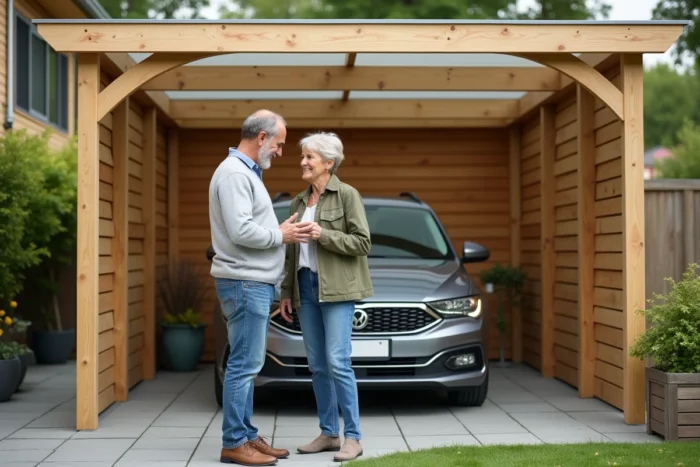
Online kit or DIY store: where to find the best value for money
Physical stores (large DIY chains) offer wooden carports at competitive prices, with the advantage of being able to check the thickness of the wood and the quality of the fittings on-site. Transport is often included or offered at a reduced rate.
Specialized online sites offer a wider choice, especially in custom carports or models with flat roofs, double slopes, or lean-tos. However, shipping costs can weigh heavily on an order of solid wood.
- In-store: tight prices on standard models, ability to see the product, quick pickup.
- Online (wood specialists): extensive range, configurators to adapt dimensions, but longer delivery times and shipping costs to check.
- Custom (local artisans): higher cost, but perfect adaptation to the terrain, the style of the house, and the constraints of the PLU.
Comparing prices without including transport systematically skews the ranking. A carport advertised at a low price with delivery charged by the weight of the wood can end up being more expensive than a slightly more expensive model delivered for free.
The right reflex is to request a complete quote: kit, delivery, fixing accessories, and roof covering if not included. It is on this total that one can truly compare a wooden carport for their garden.