
A fulfilling family life does not rely on universal recipes applied mechanically. It is built on daily micro-decisions, often counterintuitive, that alter the relational dynamics between parents and children over the long term.
Distribution of parental responsibilities: what the European birth leave changes
The new European directive on birth leave, which began discussions in 2026, aims to harmonize parental rights across the Union. Its stated goal: to promote gender equality in the workplace and enable a more balanced parental presence from the earliest months.
This regulatory framework concretely modifies family organization. When both parents have effective leave, the distribution of domestic and educational tasks adjusts more naturally. We observe that families where the second parent is involved early in daily caregiving maintain this balance well beyond early childhood.
Switzerland took a complementary path at the end of 2025 with a monthly childcare allowance for children under 8 years old in institutional settings (nursery, after-school care). The amount varies from 100 CHF per month for one day of care per week to 500 CHF for five days. Condition: both parents must engage in paid work or pursue a certified training.
This type of system forces an explicit trade-off between childcare modes, and it is precisely this conscious trade-off that structures the family page of Maman du Quotidien around concrete solutions tailored to each configuration.
Family rituals: frequency and regularity matter more than intensity
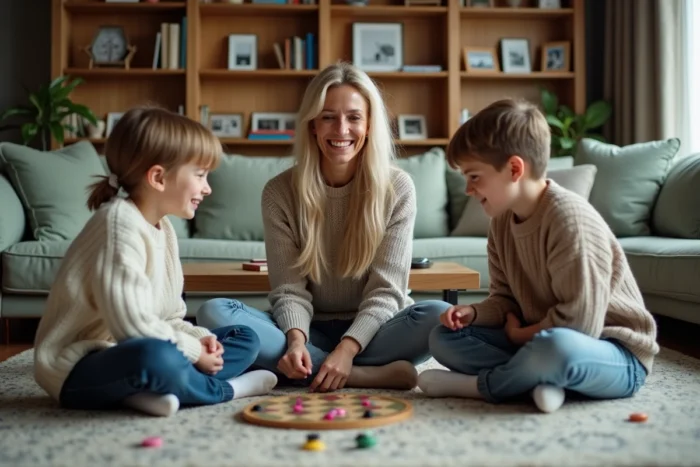
An effective ritual is one that repeats without logistical effort. Preparing a dessert together on Saturday or establishing a weekly themed dinner works better than an exceptional quarterly weekend. The reason lies in the neurobiology of attachment: the predictability of the shared moment secures the child and strengthens the sense of belonging.
We recommend distinguishing three types of rituals based on their function:
- Transition rituals (morning, after school, bedtime) that mark moments of friction. Five minutes of shared reading at bedtime better regulates end-of-day stress than a long discussion.
- Celebration rituals, even minimal: highlighting a school effort or a helping gesture during a meal creates a positive anchor. Describing what one observes (“I noticed that you helped your sister”) has a more lasting impact than a generic compliment.
- Documentation rituals: photographing or noting together a significant moment of the week. This practice, far from being anecdotal, helps children build a coherent family narrative and situate themselves within a shared story.
The classic trap is to multiply rituals to the point of overwhelming mental load. Two or three well-established rituals are better than an ambitious program abandoned after three weeks.
Active listening in parenting: technique and concrete limits
Listening to a child does not mean systematically validating their emotion. Positive parenting has popularized active listening, but its mechanical application (“I understand that you are angry”) can sound hollow if not followed by clear framing.
The effective technique relies on three steps. The first: physically silence (put down the phone, crouch down to the child’s level). The second: factually rephrase what the child expresses. The third: state the limit or decision without negotiating.
This third step is what most guides forget. A child who feels heard but never contained develops a paradoxical anxiety. The reassuring framework complements listening; it does not oppose it.
Sleep and emotional regulation
Lack of sleep degrades parents’ listening ability as much as children’s emotional regulation. A tired child cannot verbalize their frustrations. An exhausted parent cannot maintain an active listening posture. Protecting the sleep hours of the entire family is an underestimated lever for daily family flourishing.

Screen management and shared time: arbitrate rather than prohibit
Total prohibition of screens rarely works beyond early childhood. We recommend an explicit framework rather than a binary rule.
- Define screen-free slots for everyone (parents included), especially during meals and the last hour before bedtime.
- Distinguish between passive consumption (looped videos) and active use (creation, research, cooperative family play). The latter can become a shared ritual.
- Make the rule visible: a schedule displayed in the kitchen, co-constructed with children from the age of six or seven, reduces repetitive negotiations.
A child who participates in the creation of the rule respects it more durably. This principle extends beyond the issue of screens and applies to all family boundaries.
Shared time versus quality time
The notion of “quality time” can become a trap if it serves as an excuse to reduce overall presence time. The most structuring interactions often occur during unplanned moments: car rides, meal preparation, waiting at the doctor’s office. Being available without a program is as valuable as an organized activity.
Families that document their moments together (photos, notebooks, shared albums) notice an unexpected effect: the simple act of noting reinforces attention to daily life. No need for a sophisticated app; a notebook on the kitchen table is sufficient.
Family flourishing rarely hinges on major decisions. It is built on the regularity of simple gestures, the clarity of established limits, and each member’s ability to feel heard without the framework disappearing. Recent European measures on parental leave and childcare support facilitate organization, but it is the consistency of daily choices that makes the difference.