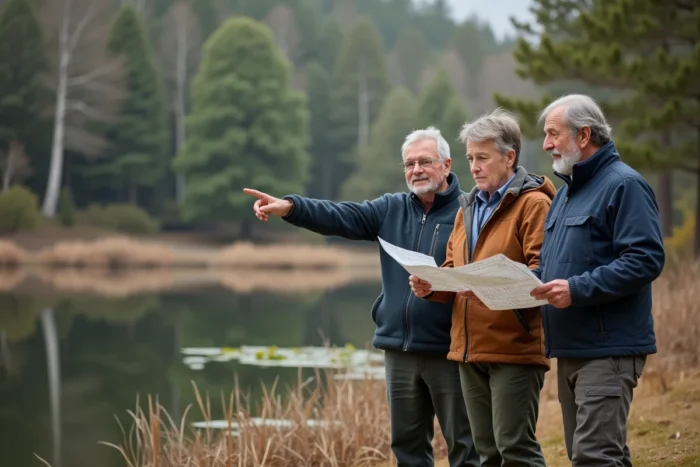
Buying a pond together is often the extension of a dream shared among friends or family. The project seems simple: we split the price, we enjoy the body of water together. But as soon as the first maintenance work begins or the first disagreement arises over the use of the banks, tensions can quickly emerge if nothing has been formalized.
Structuring the co-ownership of a pond before the notarial signature
Even before visiting a body of water, the question of the legal arrangement must be settled. There are two main options: joint ownership and a real estate civil company (SCI). Each has direct consequences on decision-making, the resale of shares, and conflict management.
Joint ownership is the default arrangement when multiple people buy together. It has a major drawback: each co-owner can trigger the division and force the sale. In practice, a single dissatisfied co-owner can block the entire group or demand the transfer of the property.
The SCI offers a more flexible framework. The statutes define the rules of majority, the conditions for transferring shares, and the management modalities. For a pond shared among four or five people, this framework prevents every decision from becoming a tug-of-war. One point deserves anticipation: you can learn more on h-immobilier.fr to understand how to draft statutes suitable for this type of atypical property.
Regardless of the chosen arrangement, the co-ownership regulations (or the SCI statutes) must specify at least three things: who decides what, how costs are shared, and what happens when someone wants to leave.
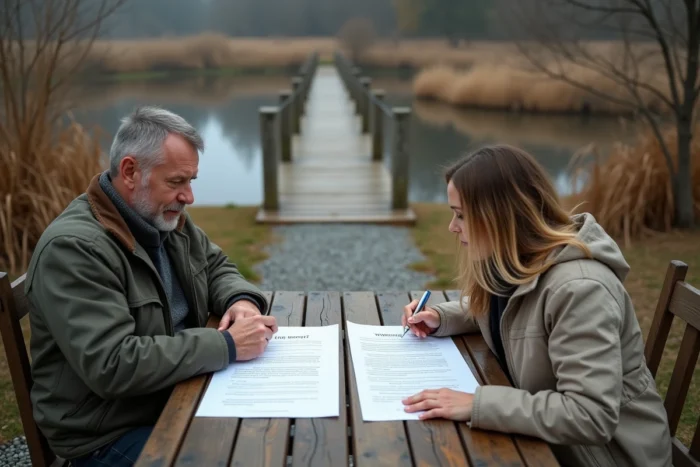
Pond co-ownership regulations: clauses not to forget
A well-drafted regulation does not just set the shares. It must anticipate the concrete situations that generate friction on a shared body of water.
Usage distribution and access schedule
Fishing, swimming, picnicking, fish farming: not all co-owners have the same expectations. Formalizing the permitted uses avoids conflicts from the very first season. A rotating access schedule works well when the number of co-owners exceeds three or four.
The statutes can also provide for reserved areas. For example, part of the banks dedicated to fishing and another accessible for swimming, with distinct periods.
Work and maintenance: mandatory voting in assembly
A recent ruling from the third civil chamber (January 29, 2026) reminds us that authorization for work on a common area can only result from an express decision of the general assembly. Simple tolerance or lack of opposition is not sufficient.
For a pond, this directly concerns interventions on the dikes, sluices, dredging, or bank development. If a co-owner decides alone to modify the hydraulic structure, the others can legally contest this work, even if done in good faith.
- Dredging the pond and maintaining the dikes must be subject to a vote in assembly, with a prior estimate communicated to all co-owners.
- Emergency work (dike breakage, accidental pollution) can be initiated by the manager without a vote, but with an obligation for immediate information and subsequent ratification.
- Any modification of the water supply or drainage structures requires compliance verification with the water police, in addition to internal voting.
Projected budget and work fund for a shared pond
Financial management is the most common breaking point in atypical co-ownerships. A pond generates recurring costs that many first-time buyers underestimate: bank maintenance, verification of hydraulic structures, management of aquatic vegetation, insurance for the body of water.
Planning a work fund from the creation of the co-ownership is the best protection against unexpected calls for funds. The logic of a multi-year renovation plan, now mandatory for certain classic co-ownerships, applies pertinently to a pond.
In practical terms, it involves planning heavy interventions (dredging, dike repair, replacement of sluice or valve) over five to ten years and budgeting each year a fraction of the estimated cost. This approach prevents a co-owner from refusing to pay their share when the work becomes urgent.
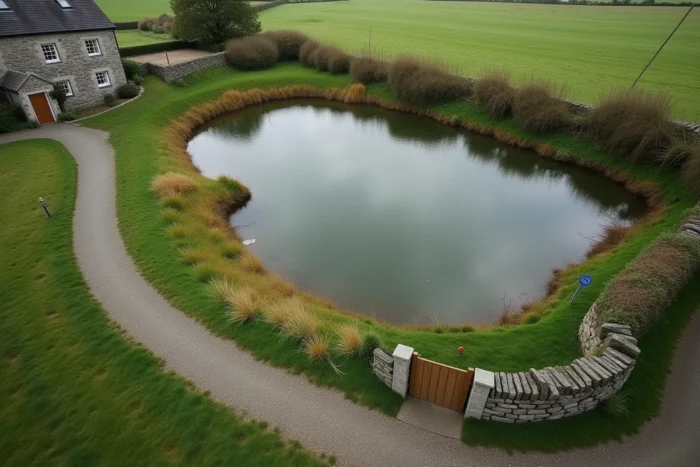
Distribution of costs: pro rata or by usage
Two models coexist. The pro rata distribution of shares is the simplest. It is suitable when all co-owners use the pond in a comparable manner.
When uses differ, a mixed key may be fairer. For example, a co-owner who exploits the pond for fish farming might bear a higher share of costs related to water quality, while the maintenance costs of access paths remain equally distributed.
Remote general assemblies and daily management
A shared pond often brings together people who do not live near the body of water. Organizing a physical general assembly can then be a logistical headache.
Virtual general assemblies are now facilitated by regulations: the property manager (or the SCI manager) must offer remote participation via videoconference or electronic voting. For a pond co-ownership where members sometimes live hundreds of kilometers away, this possibility changes everything.
In daily management, appointing a manager or a local referent simplifies coordination. This person oversees the state of the body of water, reports urgent problems, and relays information between co-owners. Their powers should be defined in writing to prevent them from making decisions that exceed their mandate.
- Regular verification of water levels and the condition of structures (sluice, spillway, dike).
- Monitoring of regulatory compliance, including the declaration of existence of the body of water with the water police.
- Managing relationships with neighbors and local authorities in case of drought or usage restrictions.
Buying a pond together remains a feasible and financially accessible project, provided that governance is treated with as much seriousness as the choice of land. A precise regulation and a budgeted work fund better protect the group’s cohesion than any oral promise made by the water’s edge.