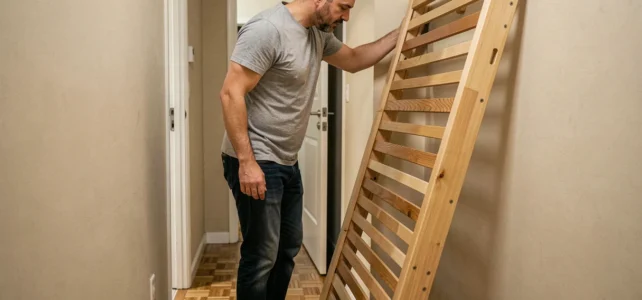
A large bed base rarely passes straight through a hallway or staircase. Weight is not the limiting factor: it is the combination of the frame’s bulk and the passage’s geometry that blocks it. Before forcing it, one must map out the route and adapt the technique to each obstacle.
Narrow passage and tight angle: the geometric constraint of the bed base
A standard slatted bed base measures between 140 and 160 cm wide. Most interior doors offer a clear passage of about 73 cm, and stair landings rarely exceed 90 cm of usable depth. The problem boils down to a dimensional incompatibility that neither strength nor speed can resolve.
We recommend measuring each passage point before any move. Three measurements are sufficient: door width (including the frame), depth of the turning landing, and ceiling height in the staircase. Compare these with the overall dimensions of the bed base, with the legs removed.
The vertical position is almost always the only option in a staircase. By tilting the bed base on its edge, the footprint goes from 140 cm to the thickness of the frame, which is about fifteen centimeters. The pivoting then occurs gradually, by bracing one angle against the wall (protected by a blanket) and sliding the other end.
For a 90° turn on a narrow landing, the so-called “pendulum” method works well: tilt the bed base at about 45°, first engage the upper corner into the opening, then pivot the base in an arc. You will find more tips for moving a bed base that detail the grips suitable for this type of maneuver.
Dismantling a slatted bed base: what can be removed and what should not
Removing the slats and legs before any move reduces bulk and the risk of breakage. On a classic upholstered bed base, the legs can be unscrewed or unclipped. The visible slats lift off their ends. Gather the screws in a bag attached to the frame with tape.
Some slatted bed bases are riveted or stapled to the chassis. Forcing the disassembly on this type of fastening damages the ends and misaligns them during reassembly. In this case, it is better to keep the bed base assembled and work only on the trajectory.
Storage bed bases pose an additional problem: the gas lift mechanism extends from the frame and catches on door frames. We find that removing the gas lifts (two screws per lift on most models) allows the top to fold completely flat against the box, simplifying the passage in a vertical position.
Two-part bed base: a real advantage
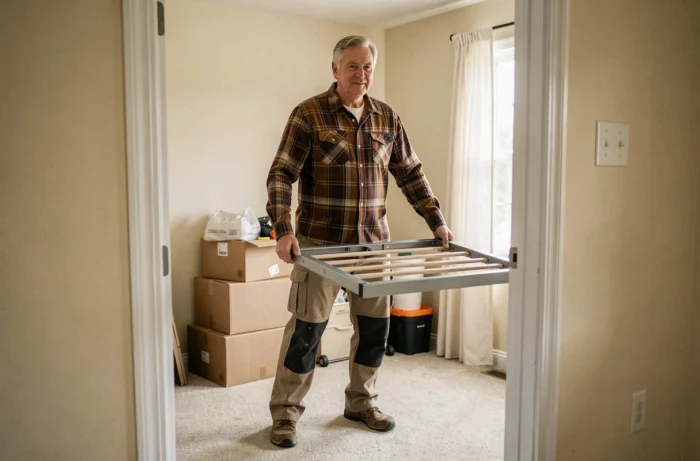
Articulated or two-piece bed bases of 70 or 80 cm wide pass through almost all standard doors without going vertical. If you are considering a replacement, this is a criterion not to be overlooked for older homes.
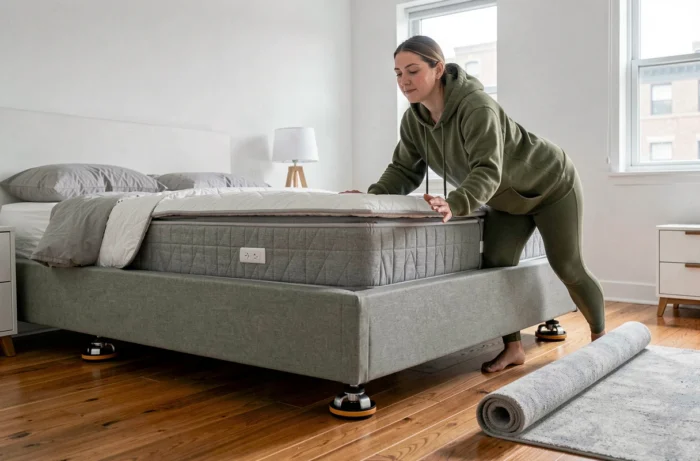
Slide rather than lift: protect the floor and save effort
Lifting a bed base alone over several meters is unnecessary and risky for the back. The load should remain on the ground as long as possible. Several solutions allow it to slide without scratching the flooring:
- Felt or Teflon sliding pads, placed under each corner of the frame, work on hardwood, tile, and laminate. They support significant loads and cost a few euros.
- An old carpet turned upside down (textile side against the ground) or thick cardboard folded double creates an effective temporary sliding surface on hard floors.
- A hand truck with a strap allows you to tilt the bed base on its edge and roll it over long distances (hallway, sidewalk to the vehicle).
Always push with your legs, not with your back. Keep the bed base as close to your body as possible. A bulky object held at arm’s length becomes significantly harder to control and increases lumbar strain.
Protecting the bed base during transport in a vehicle
An upholstered bed base exposed to rain, friction against the walls of a van, or contact with sharp objects can tear or deform. Wrap the frame in moving blankets secured with stretch film or flat straps.
In the vehicle, the bed base ideally fits vertically, leaning against a side wall. This position limits the footprint and prevents another object from falling on it. Two ratchet straps fixed to the vehicle’s anchor points prevent any tipping during transit.
Bed base on roof rack: the limits
Transporting a bed base on the roof of a vehicle is technically possible, but the wind resistance is considerable. Beyond a moderate speed, the bed base acts like a sail and dangerously strains the roof bars. We discourage this option except for very short trips at low speeds, with reinforced securing (at least four straps, passed through the cabin).
Safety and technical gestures for handling a bulky load alone
The main risk is not muscular: it is loss of control. A bed base tilted vertically in a staircase can gain momentum if you let go. A few principles reduce this risk:
- Wear closed shoes with non-slip soles. Socks on tile are the leading cause of slipping during a move.
- Clear the entire path before starting: rugs, shoes, objects on the ground, doors held open with wedges.
- Take a break at each change of direction. Rest the bed base on the ground, reposition your grips, then continue.
- Never pull a bed base down a staircase while walking backward. Lower it in front of you, controlling the slide with your weight.
A bed base that does not fit despite all these maneuvers raises a legitimate question: should one consider passing it through the window with a lifting system, or simply replace the bed base with a two-part model? The answer depends on the value of the bed base and how often you will need to make this trip. In an old building without an elevator, a large monobloc bed base remains a burdensome choice in the long term.