
The code DTC038061 is a Renault proprietary fault code, distinct from generic OBD-II codes like P0380. It indicates an anomaly in the preheating circuit of diesel engines, but its reading and interpretation require manufacturer tools (CLIP, DDT4ALL) or Renault/Dacia matching databases. This specificity changes the diagnostic method compared to a simple reading via a universal OBD scanner.
Manufacturer fault or generic OBD code: why DTC038061 is read differently
On most vehicles, a P0380 code appears in any OBD-II reader. The DTC038061, however, belongs to Renault’s internal nomenclature. Generic scanners may display it in a truncated form, convert it to P0380, or not retrieve it at all.
This difference has a direct consequence: clearing a code using a low-end OBD tool can mask the fault without resolving it, or even prevent reading the freeze frames (conditions frozen at the time of the fault occurrence). This data, recorded by the engine control unit, indicates the coolant temperature, battery voltage, and engine speed at the time of the failure. Losing it means diagnosing blindly.
Before clearing anything, the best practice is to note the fault status: present, stored, intermittent. An intermittent fault that only reappears when cold points to an intermittent electrical problem. A fault that is permanently present indicates a clear failure, often a broken glow plug or a malfunctioning preheating module. A detailed guide on the DTC038061 anomaly on Renault and Dacia helps to better understand the different failure scenarios.
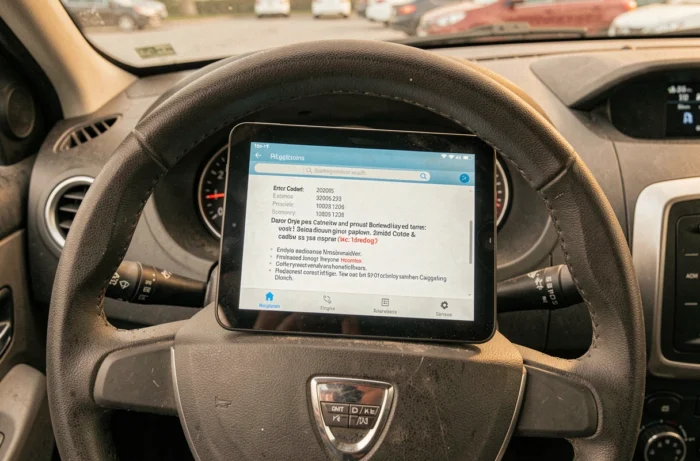
Sorting DTC038061: real failure, false positive, or reading issue
Not all DTC038061 codes indicate a failure in the preheating system. Three scenarios arise, and distinguishing them avoids unnecessary part replacements.
Real preheating fault
The fault is present, the vehicle starts hard when cold, and white smoke lingers for a few seconds after starting the engine. The preheating circuit is no longer functioning: one or more glow plugs are not heating, or the control module is no longer supplying them.
Verification is done with a multimeter on each glow plug, engine cold, measuring the resistance. A glow plug with an open circuit (infinite resistance) is faulty. If all glow plugs are correct, the preheating module (or relay, depending on engine generations) becomes the main suspect.
False positive related to voltage or power supply
A weak battery, oxidized ground on the engine block, or a corroded connector on the preheating harness can drop the voltage when the control unit powers the glow plugs. The control unit detects a discrepancy between the expected voltage and the measured voltage and records the fault.
- Measure the battery voltage with the engine off: a value significantly below the nominal voltage indicates a battery nearing the end of its life.
- Check the battery terminals and the ground strap between the engine and the body. Abnormal resistance at this level skews the entire measurement chain of the control unit.
- Inspect the connector of the preheating module. On K9K and dCi engines, connector oxidation is a common cause of intermittent faults that disappear in dry weather and return in wet weather.
OBD or CLIP reading issue
A poor-quality OBD cable, a dirty diagnostic socket, or outdated software can generate an erroneous or misinterpreted code. Before disassembling anything under the hood, it is essential to validate that the fault is confirmed by a second diagnostic tool, ideally the manufacturer tool CLIP or DDT4ALL with a recent database.
Diagnostic procedure for Renault diesel preheating circuit
Once sorting is done, the diagnosis follows a logical order from general power supply to terminal components.
Start with the preheating fuse, located in the fuse box in the engine compartment. On most Renault and Dacia diesel vehicles, it is a high-amperage fuse. A blown fuse indicates a short circuit in the downstream circuit, not just a worn glow plug.
Next, measure the voltage output from the preheating module, engine cold, with the ignition on. The control unit should command the power supply to the glow plugs for a few seconds. If the voltage reaches the module but does not go out to the glow plugs, the preheating module is faulty. If the voltage comes out of the module but does not reach the glow plugs, the problem lies in the wiring or intermediate connectors.
Individually test each glow plug by measuring its resistance. A functional glow plug has low resistance. Infinite resistance confirms a broken glow plug. It is tempting to replace only the faulty glow plug, but on a high-mileage engine, the remaining plugs often approach the same wear.

Common pitfalls on K9K and dCi engines
Replacing glow plugs on Renault/Dacia engines can turn into a mechanical nightmare if the plugs are stuck in the cylinder head. Forcing the unscrewing when cold breaks the plug, and extracting the remaining body requires specific tools, sometimes necessitating the removal of the cylinder head.
The preventive method is to run the engine for a few minutes to expand the aluminum of the cylinder head, then apply a penetrating oil to the threads before any attempt. Tightening new plugs to the recommended torque, never just by hand, prevents recurrence.
- Do not clear the fault code before recording the freeze frames and the fault status.
- Do not replace the plugs without checking the upstream supply (battery, ground, fuse, module).
- Do not force the unscrewing of a plug on a cold engine.
- Check that the fault does not return after several cold start cycles, not just after a hot reset.
DTC038061 remains a well-documented fault in the Renault/Dacia ecosystem. The difficulty lies not in the complexity of the repair but in the initial sorting between clear failure, electrical false positive, and reading artifact. Taking the time for this sorting before ordering parts saves time and money on the final bill.