
The Moto Guzzi V85 TT, with its air-cooled V-twin engine, generates noticeable heat under certain usage conditions. Measuring the actual extent of this overheating requires distinguishing between what constitutes normal behavior for an air-cooled engine and what indicates a malfunction. Several technical factors, including oil capacity, engine speed, and ignition mapping, directly influence the operating temperature of this machine.
Oil Capacity and Heat Dissipation: V85 TT vs. V9
Comparing it to another Moto Guzzi model, the V9, helps to understand why the V85 TT runs hotter. Data shared by owners on specialized forums highlight a structural imbalance between the heat produced and the capacity for dissipation.
| Parameter | Moto Guzzi V85 TT | Moto Guzzi V9 |
|---|---|---|
| Oil Capacity | Approximately 1.8 liters | Approximately 2 liters |
| Typical Engine Speed | Higher (about 1,500 RPM more) | Lower |
| Additional Torque | +10 lb-ft across the range | Reference |
| Engine Cover | Protects the oil tank, limits ventilation | More open configuration |
| Engine Mapping | Leaner mixture (emission standards) | Less constrained mixture |
Thus, the V85 TT produces more heat while having a lower oil capacity and a cover that restricts ventilation. This double disadvantage explains why the temperature rises more quickly, especially in the city or at low speeds in hot weather.
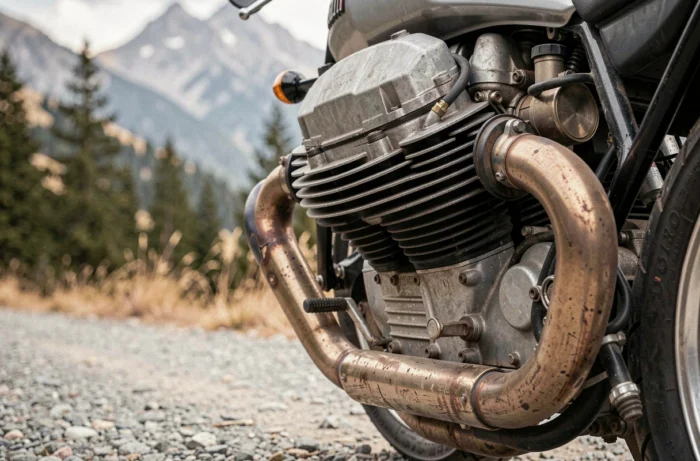
The engine cover plays a central role in this phenomenon. Some owners have drilled additional ventilation holes in the cover or even removed it to improve airflow around the oil tank. Understanding the issue with the Moto Guzzi V85 TT involves this analysis of the often-underestimated passive cooling circuit.
Ignition Mapping Updates on Early Models
The early models of the V85 TT exhibited aggravated symptoms: high-temperature knocking, rough engine operation in hot weather, degraded acceleration. These manifestations went beyond mere thermal discomfort and indicated a software tuning that could be improved.
Moto Guzzi responded with three successive revisions of the ignition mapping on these early series. Each update aimed to make the ignition less aggressive in certain load and temperature ranges. The goal: to reduce the risk of knocking and lower the temperature felt by the rider in slow traffic.
These software corrections represent a lever often overlooked by owners who have not had their machine serviced at a dealership since purchase. A visit to an authorized dealer allows for checking whether the latest version of the ECU mapping is properly installed.
How to Check Your Mapping Version
The diagnosis is performed using the manufacturer’s tool at the dealership. There is no simple way for the owner to independently verify the installed software version. If the motorcycle exhibits recurring knocking when hot or erratic behavior above certain temperatures, the ECU update should be the first avenue explored before any mechanical intervention.
Cover Ventilation and Physical Modifications Against Overheating
Beyond the software, physical interventions on the engine cover represent the most common modification within the V85 TT community. The original cover, designed to protect the lower engine components, creates a greenhouse effect around the oil tank.
- Drilling ventilation holes in the cover: improves airflow without removing mechanical protection. The number and diameter of the holes vary based on user experiences, but the goal remains to promote an upward airflow around the oil tank.
- Complete removal of the engine cover: a radical solution that exposes the oil tank to open air. Thermally effective, it eliminates protection against splashes and impacts.
- Regular monitoring of the engine oil level: with only 1.8 liters of capacity, any slight drop in level reduces the thermal mass available to absorb heat. Maintaining the oil level at maximum directly contributes to limiting temperature rise.
These modifications are not trivial. Poorly executed drilling of the cover can generate metal shavings that are dangerous for the engine. A workshop familiar with Guzzi is preferable for this type of intervention.

Lean Mapping and Emission Standards: The Hidden Factor
The V85 TT operates with a leaner air-fuel mixture than its predecessors to comply with emission standards. A lean mixture burns at a higher temperature, which directly contributes to engine overheating.
This parameter cannot be modified without intervention on the ECU. Some owners have opted for an additional module or a reprogramming of the injection to slightly enrich the mixture. However, this modification may pose compliance issues during technical inspections and void the manufacturer’s warranty.
Adapting Your Riding in the City During Hot Weather
The overheating of the V85 TT primarily manifests at low speeds when the natural airflow is no longer sufficient to cool the cylinders. The built-in fan automatically activates beyond a certain temperature threshold, but its effectiveness remains limited in prolonged traffic jams.
Avoiding high RPMs while stationary, turning off the engine during prolonged waits at traffic lights, and favoring smooth routes in high heat are simple reflexes that significantly reduce the operating temperature of the engine.
Overheating on the V85 TT results from a combination of design choices (reduced oil capacity, closed cover, lean mapping) rather than an isolated defect. The three mapping revisions applied by Moto Guzzi on the early models address part of the problem. For the rest, the combination of a monitored oil level, a ventilated cover, and adapted riding in the city covers most situations encountered by owners.