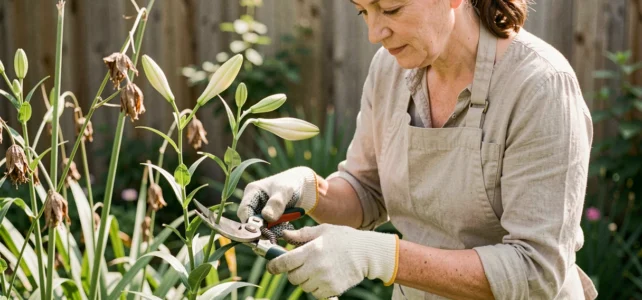
After cutting the faded flowers, the lily enters a reconstitution phase that determines the quality of its blooming the following year. The bulb, deprived of its flowers, then relies entirely on the remaining foliage to accumulate the necessary reserves for the next season. Properly maintaining your lilies after cutting involves three specific levers: maintaining the foliage, appropriate fertilization, and managing winter dormancy.
Role of functional foliage in the reconstitution of the lily bulb
The most common reflex after cutting faded flowers is to cut back the stems and leaves to “clean up” the bed. This action most compromises the next blooming.
As long as the leaves remain green, they ensure the photosynthesis that allows the bulb to store carbohydrates and nutrients. Never cut the foliage until it has completely yellowed, even if the plant looks untidy. This recommendation, long stated vaguely, has become a central point in recent gardening guides: we now speak of prolonged foliage as an active strategy, not just a precaution.
In concrete terms, several weeks separate the end of blooming from complete yellowing. During this period, maintain moderate watering without ever letting the soil become waterlogged. To find more gardening tips on D Kom Déco, the logic remains the same: support the plant rather than forcing it into dormancy.
Once all the leaves have turned yellow and then brown, cut the stems down to the ground with clean pruning shears. Not before.
Fertilizing lilies after cutting: what fertilizer and how often
Cutting the faded flowers removes an organ that consumed a lot of resources. The bulb needs targeted input to compensate for this effort and prepare the buds for the following year.
Type of fertilizer suitable for lily bulbs
Opt for a fertilizer rich in potassium and low in nitrogen. Potassium strengthens the bulb and promotes future blooming, while an excess of nitrogen stimulates foliage production at the expense of deep reserves. A fertilizer for flowering plants or bulbs is perfectly suitable.
Apply this fertilizer as soon as the flowers are cut, as long as the foliage is still green and active. Stop all fertilization once the leaves begin to yellow: the bulb then enters dormancy and no longer absorbs nutrients in the same way.
Soil and drainage around the bulb
Lilies hate standing water. Poorly drained soil after cutting causes bulb rot much more often than winter cold. If your soil is clayey, add well-decomposed compost or gravel on the surface to improve drainage.
- Check that water does not pool around the base of the stems after rain, a sign of insufficient drainage.
- Lightly mulch with fallen leaves or pine bark to maintain consistent moisture without excess.
- Avoid digging too close to the bulbs: the shallow roots still nourish the plant during the reconstitution phase.
Potted lilies after cutting: specific cultivation constraints
Potted lilies face constraints that are naturally mitigated in the ground. The limited substrate volume concentrates moisture and mineral salts, making every watering or fertilization error more consequential.
After cutting the flowers, gradually reduce watering without stopping it completely. The substrate should remain barely moist on the surface. A pot with wide drainage holes remains the basic condition: without proper drainage, the bulb rots within weeks.
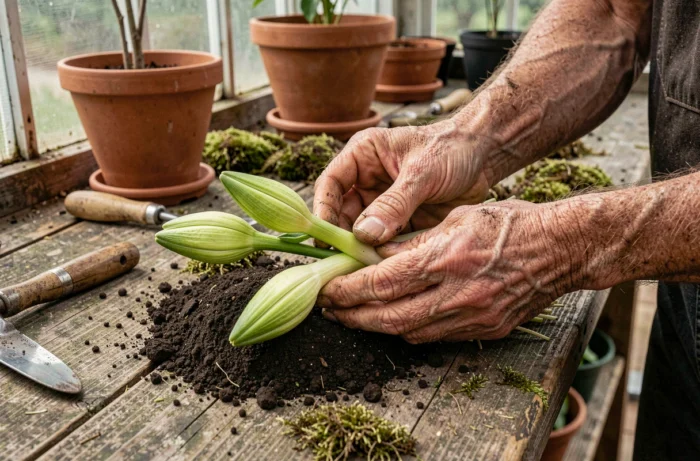
When the foliage has completely yellowed and the stems are dry, two options arise. Either you leave the bulb in its pot, stored in a cool, dry place for the winter. Or you dig it up, clean it, and store it in a net or paper bag, away from moisture, until the next planting.

The second option is preferable if your substrate is exhausted after a full season. Replanting in fresh mix the following spring yields better results than leaving the bulb in depleted potting soil.
Preparing lily bulbs for winter and replanting
The winter phase is a period of dormancy, not abandonment. The care given between autumn and early spring determines the vigor of regrowth.
Bulbs left in the ground
Most varieties of lilies (Oriental, Asian) withstand the cold if the soil drains properly. Apply a layer of mulch several centimeters thick before the first frosts to insulate the bulbs from sudden temperature variations. Mulching protects the bulb from frost without retaining excess moisture if you use an airy material like dry leaves or straw.
Bulbs dug up and stored
If you grow frost-sensitive varieties or if your soil is very heavy, dig up the bulbs once the foliage is completely dry. Inspect each bulb: discard those showing signs of mold or soft parts.
- Let the bulbs dry for a few days in a ventilated place before storing them.
- Place them in dry peat, sand, or vermiculite, in a cool but frost-free location.
- Check the condition of the bulbs once a month during winter to spot any signs of rot.
Bulb division occurs at this time: separate the small bulbils formed around the main bulb and replant them in spring to multiply your lilies at no extra cost.
At the time of replanting, choose a location that receives sun at the top and keeps the feet in shade, which gardeners summarize as “the head in the sun, the foot in the shade.” A soil enriched with compost and well-drained remains the best starting mix for achieving generous blooming from the first year of regrowth.