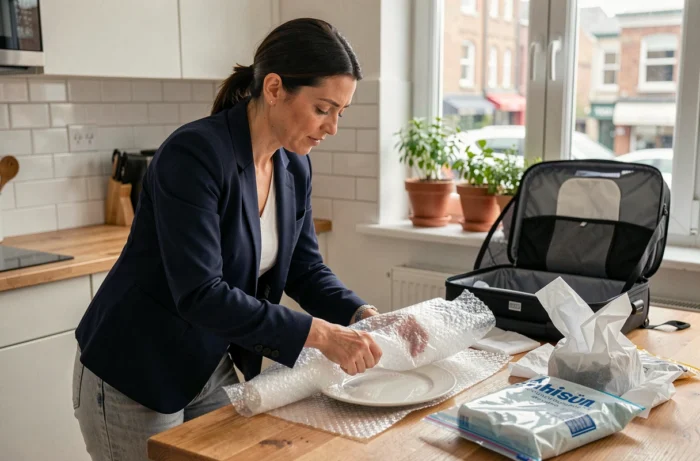
Transporting dishes in the cabin raises a practical question that Air France’s pages do not address directly. The airline does not classify plates, cups, or bowls among prohibited items, but their acceptance depends on compliance with baggage size limits and the absence of items that can be considered sharp or blunt objects. Understanding the weight thresholds, allowed dimensions, and concrete risks at security checks allows for anticipating potential issues before departure.
Weight limits and cabin dimensions for Air France by travel class
| Class | Max dimensions for carry-on baggage | Max weight for carry-on baggage |
|---|---|---|
| Economy / Premium Economy | 55 x 35 x 25 cm | 12 kg |
| Business / La Première | 55 x 35 x 25 cm | 18 kg |
These thresholds apply to carry-on baggage, excluding personal accessories (small bags). The dishes must fit within this volume and not exceed the total weight. A complete set of earthenware or stoneware can weigh several kilograms: in Economy, the remaining allowance for clothing and personal items decreases quickly.
Anyone traveling in the cabin with dishes in the cabin with Air France must weigh their baggage before departure, including the dishes, to stay within the limit for their class.
Fragile dishes in the cabin or in the hold: what Air France’s policy implies
Air France recommends placing fragile or valuable items in the cabin rather than in the hold. This recommendation is included in the general conditions of transport and specifically targets the categories of “fragile items,” including porcelain, glass, and handmade ceramics.
The reason is contractual. Air France’s liability for checked baggage remains limited, particularly for the breakage of fragile items. In the event of breakage in the hold, the airline may refuse any compensation if the item was not declared or if the packaging is deemed insufficient.
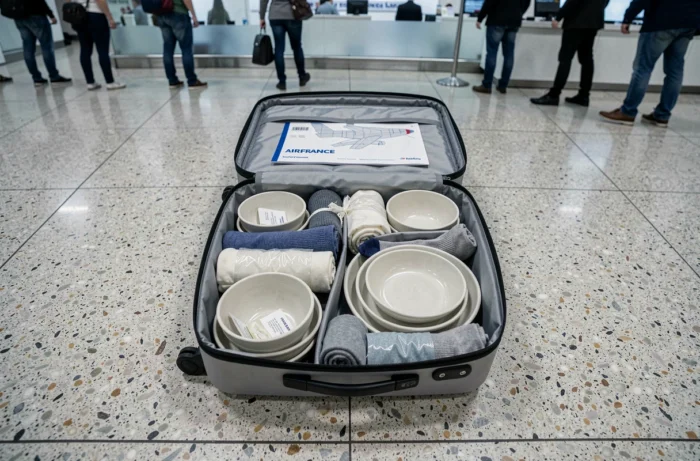
On the other hand, placing dishes in the cabin transfers the responsibility for protection to the passenger but ensures direct control over handling. The overhead compartment experiences fewer shocks than the baggage sorting belt.
Packaging and passing through security control
Security control is the real point of friction. Agents examine any dense or opaque object at the scanner. A stack of plates wrapped in bubble wrap may trigger a manual inspection, which prolongs the passage.
- Ceramic, porcelain, or glass dishes pass through the scanner without particular restrictions, provided they do not conceal any liquid or suspicious substance.
- Table knives, even with rounded blades, are on the list of prohibited items in the cabin. A complete set of cutlery must travel in the hold.
- Heavy metal objects (cast iron dishes, Dutch ovens) may be considered blunt objects. Their acceptance depends on the security agent’s assessment at the checkpoint.
A cheese knife or kitchen knife remains prohibited in the cabin, even if wrapped. The distinction between dishes and cutting utensils is strict.
Glass and porcelain items: real risks at security and in-flight
Glass and porcelain are not on Air France’s list of prohibited items nor on the list published by the European air safety regulation. A vase, a decorative dish, or a porcelain tea set can pass without issue if no part has an exposed sharp edge.
The main risk is breakage during the flight. An object made of glass that breaks in the overhead compartment can create dangerous shards for passengers. Wrapping each piece individually in bubble wrap or fabric reduces this risk and facilitates passage through the scanner, as agents can identify the nature of the object more quickly.
A rarely mentioned point: some pieces of handmade dishes contain metallic parts (gold trim, metal attachment on a lid). These metallic elements consistently trigger the scanner and cause baggage to be opened. Nothing blocking, but it does cause a delay at screening.
Maximum quantity and realistic weight of a dish set in the cabin
No Air France rule specifies a maximum number of dish pieces. The only constraint remains the total weight of the carry-on baggage and its volume.
To provide a concrete order of magnitude:
- A standard flat porcelain plate weighs between 400 and 600 g depending on the diameter.
- A stoneware mug weighs between 300 and 500 g.
- Bubble wrap adds volume without significant weight but reduces the available space for other belongings.
In Economy, with 12 kg of cabin allowance, carrying six plates and four mugs already consumes half of the allowed weight. The passenger must decide between the quantity of dishes and their other personal effects.
In Business or La Première, the allowance of 18 kg offers a more comfortable margin. A set of twelve pieces wrapped fits in a cabin-sized hard case, provided it does not exceed 55 x 35 x 25 cm when closed.
Dishes purchased in duty-free and oversized items
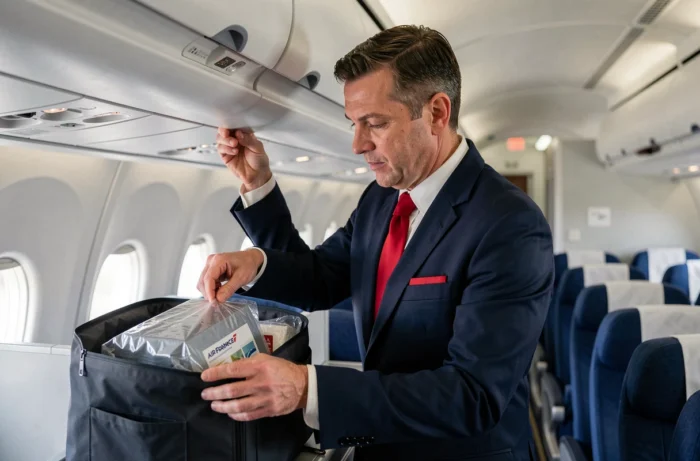
Purchases made in the duty-free area after security control are allowed in addition to carry-on baggage, provided they remain in their sealed bag. A dish or decorative item purchased in an airport shop can therefore be added to the carry-on baggage without counting towards the weight allowance.
This exception only applies to purchases made after screening, in the boarding area. An item bought in the city and packed in a similar bag does not benefit from this tolerance.
For large items that exceed cabin size limits (large serving platters, soup tureens), the only option remains checked baggage, ideally in a hard suitcase with internal padding. Air France accepts fragile baggage in the hold, but declaring the value at the check-in counter is the only way to obtain coverage in case of damage.
Dishes can therefore travel in the Air France cabin without principle restrictions. The real constraint is physical: weight, volume, and packaging quality determine whether the plan is viable. Weighing the complete baggage before leaving for the airport remains the most reliable action to avoid an unpleasant surprise at boarding.