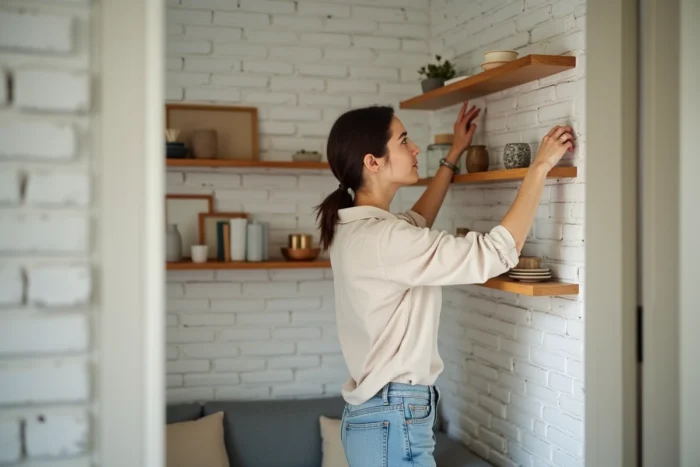
A 45 m² apartment requires choices that 80 m² allows you to avoid. Buying smaller means confronting each object with a simple question: do I really use it? This sorting, often dreaded, profoundly transforms how one occupies their interior and thinks about daily organization.
Regulatory constraints of small spaces: what the market imposes
Buying small does not mean buying just anything. In Paris, a main room must have at least 9 m² of floor space with a ceiling height of 2.20 m and a minimum habitable volume of 20 m³ to be considered decent.
These thresholds are not decorative. A dwelling that does not meet them can be declared indecent, with possible recourse for the tenant and orders for unsanitary conditions. If you buy a studio to rent it out, checking these criteria before signing avoids serious legal complications.
Since May 2026, the Le Meur law requires the registration of each furnished tourist rental on a unique national online service. This system verifies compliance with decency criteria. For those wishing to discover trends on Immobilier du Net, the tightening of regulations is now an integral part of the calculation before any purchase of a small space.
Storage optimization: the zone method
In a small space, organizing is not about stacking better. It involves dividing your interior into functional zones and assigning each zone a specific use.
Have you ever noticed that a catch-all drawer always ends up full, no matter its size? This is the principle of Parkinson’s law applied to storage: clutter expands to fill the available space. Reducing the living area breaks this mechanism.
Dividing the space into micro-zones
The method involves identifying three types of zones in each room:
- The active zone, where items used every day are located (kitchen countertop, desk, bedside table). These items remain easily accessible.
- The rotation zone, for items used weekly or monthly (household equipment, current seasonal clothing). These are stored up high or in closed furniture.
- The deep storage zone, reserved for seasonal or sentimental items. In a small dwelling, this zone is often externalized (cellar, storage unit).
This division avoids the classic trap: buying additional storage furniture that ultimately consumes more square meters than it frees up.
Multifunctional furniture: utilizing every square meter without cluttering
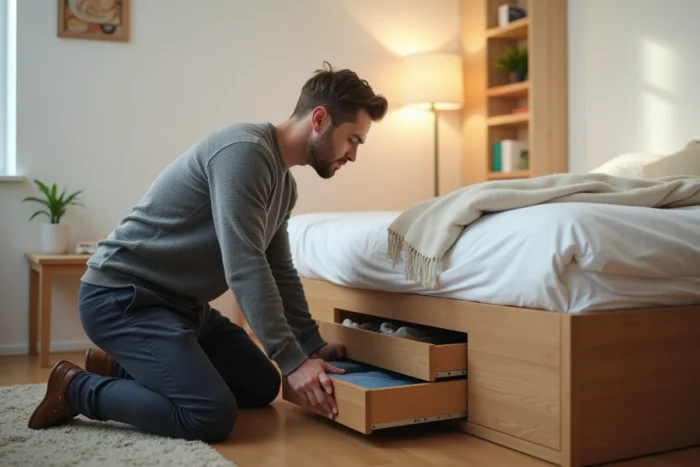
A bed with built-in drawers replaces a dresser. An extendable table serves both as a desk and a dining area. In a small interior, each piece of furniture must fulfill at least two functions to deserve its place.
Why this choice? Because a compact apartment does not forgive decorative furniture without real use. Multifunctional furniture reduces the total number of pieces to install, which frees up circulation and gives a sense of space larger than the actual area.
Three concrete considerations before buying a piece of furniture
Before adding anything to a small dwelling, three questions filter out most unnecessary purchases:
- Does this piece of furniture replace another existing item, or does it add to it? If it’s an addition, the net space decreases.
- Can it fold, slide under another piece of furniture, or be mounted on the wall? A piece of furniture that permanently occupies floor space is costly in terms of living area.
- Will I use it every week? An item used less than once a month in a small space is a serious candidate for external storage.
In the kitchen, this reasoning often leads to replacing a central island with a foldable wall-mounted countertop or choosing vertical storage that utilizes height rather than depth.

Life project and space: how reducing size changes habits
Buying smaller is not just a financial calculation. According to the 2023 Taskrabbit report, the platform recorded nine times more requests for apartment moves than house moves. The reasons vary: children leaving home, separation, a desire to spend less time maintaining the dwelling.
A reduced space also forces regular sorting. Each new item coming in often implies an item going out. This mechanism, sometimes called “domestic tight flow,” gradually alters the relationship with purchases.
Living in a small space encourages buying less but better. The budget allocated for furniture focuses on durable and suitable pieces rather than impulsive purchases that end up at the back of a closet.
The impact on ongoing expenses
Fewer square meters also mean less space to heat, light, and maintain. A significant portion of buyers who reduce their space report wanting to lighten their energy bills. The DPE (energy performance diagnosis), which has become an increasingly scrutinized criterion, weighs more heavily on poorly insulated large spaces than on a small, well-designed recent dwelling.
In this context, storage is no longer a problem to be solved with additional furniture. It is a discipline that accompanies a life choice. An interior of 35 m² organized by zones and equipped with multifunctional furniture allows for more circulation space than a dwelling twice as large where each room accumulates unused items.