
You turn on the light in the middle of the night and a spider is there, on your sheet. The reflex is often to jump, sometimes to crush the intruder. Before acting out of panic, a few simple reflexes can help manage the situation without stress and without risk to you or the spider.
Why a spider ends up in your bed at night
The spider did not come for you. It is looking for food, which means small insects attracted by body heat or the standby light of an electronic device. Your bed is just a stop on its hunting route.
Biologists have also debunked the legend that we swallow spiders while sleeping. Spiders are very sensitive to the vibrations of our breathing and movements. They have no reason to climb onto a sleeping human body, except for purely accidental contact.
If you are looking to understand what to do with a spider in bed, the first thing to remember is that its presence is usually temporary and does not pose a danger in the vast majority of cases in France.
Spider in the bedroom: the immediate action to take
You have spotted the spider. What should you do right away?
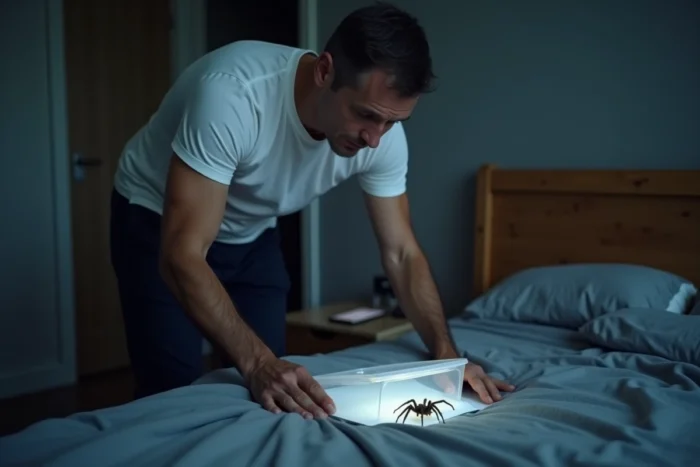
Take a glass or a transparent jar and a stiff piece of paper (a postcard works well). Place the glass over the spider, slide the paper underneath, then turn the whole thing over. You can then release the spider outside or in another room.
Do not crush it in the bed. The remains can stain the sheet, and above all, the spider plays a useful role in your home. A single house spider consumes a notable amount of mosquitoes, gnats, and other small harmful insects.
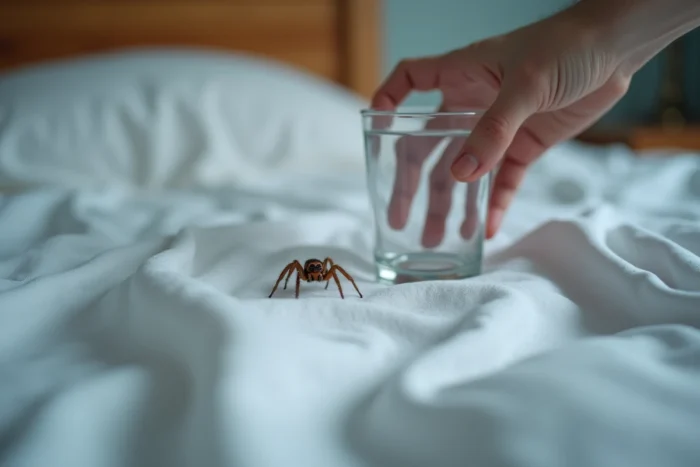
If you are hesitant to capture it, a simple breath or a light tap with a newspaper beside it is enough to make it flee from the bed. It will seek a quieter corner, away from your movements.
Repeated presence of spiders: a signal of an invisible problem
Finding a spider once in your bed is trivial. Regularly finding one in the same spot deserves your attention.
A spider that keeps returning to the same spot often reveals an invisible disorder in the room. Three common causes are:
- A damaged or poorly fitted window seal, which lets insects in (and therefore the spiders that hunt them)
- An excessively high humidity level, related to insufficient ventilation or a nearby plumbing issue
- An accumulation of small insects attracted by crumbs, dust under the bed, or constant nighttime lighting
Addressing these points often makes spiders disappear without any chemical treatment. Check the seals on your windows, air out the room every morning, and vacuum under the bed and behind the headboard regularly.
Common confusion with bedbugs
Before worrying, make sure you are indeed dealing with a spider. Bedbugs, which are smaller and flattened, hide in the seams of the mattress and leave small dark spots on the sheets.
A spider leaves no trace on bed linen. If you notice aligned bites on your skin upon waking, it is probably not a spider, but another insect. Spiders found in homes in France very rarely bite, and only if they feel trapped against the skin.
Spider bite at night: real risk in France
In metropolitan France, most house spiders do not have fangs strong enough to pierce human skin. Among the species that can, bites remain rare and benign.
A spider bite resembles a small redness, sometimes slightly swollen, that disappears within a few days. Consult a doctor only if the redness spreads, if sharp pain persists, or if general symptoms appear (fever, nausea).
The common house spider, the most prevalent in French homes, can be impressive due to its size. Its long legs and brown body make it very visible. However, it is completely harmless to humans and prefers to flee rather than bite.
Keeping spiders away from your bed without chemicals
Pesticides are not the right answer. They contaminate your sleeping space and also eliminate beneficial insects. A few simple habits work better in the long run.
- Move the bed frame a few centimeters away from the wall to cut off the “bridges” that the spider uses to climb
- Avoid storing boxes, clothes, or books under the bed, as these dark areas attract spiders
- Reduce outdoor lighting near the bedroom windows in the evening: light attracts flying insects, which attract spiders
- Place a few leaves of fresh mint or dried lavender near the head of the bed, as spiders avoid these scents
Regular cleaning remains the most effective method. Vacuuming corners, under furniture, and around windows eliminates webs, egg sacs, and small insects that spiders feed on.
If you use a vacuum to remove a web or nest, empty the bag or container outside. A spider can survive in a vacuum cleaner and come back out.
Finding a spider in your bed remains a non-issue in France. Capturing it with a glass and a piece of paper takes less than a minute. If the phenomenon recurs, inspect the window seals and the humidity level in the room rather than looking for spider treatments. The problem is almost always resolved by correcting what attracts insects into the room.