
On a a renovation site, we regularly come across junction boxes without an earth wire. The intended fixture is a class 1 metal ceiling light, but the installation does not allow for an earth connection without rewiring. Should we change the fixture or redo the line? This kind of situation requires a concrete understanding of what separates a class 1 fixture from a class 2 fixture, beyond the symbols printed on the packaging.
Absent earth wire: when the class of the fixture dictates the site
A class 1 fixture relies on a grounding of its accessible metal parts. If the internal insulation fails, the fault current is discharged through the protective conductor to the ground, and the residual current device cuts off the circuit. Therefore, the metal of the fixture never remains live.
A class 2 fixture operates without an earth. Its safety relies entirely on double insulation or reinforced insulation between the live parts and the user. No accessible metal part is connected to the electrical circuit. The double square symbol on the label confirms this design.
The consequence on the ground is direct: in an old dwelling where the earth wire does not reach the light point, installing a class 1 fixture without an earth connection constitutes a non-compliance issue. We better understand the differences between class 2 and class 1 fixtures when faced with a two-wire wiring at the end of the line.
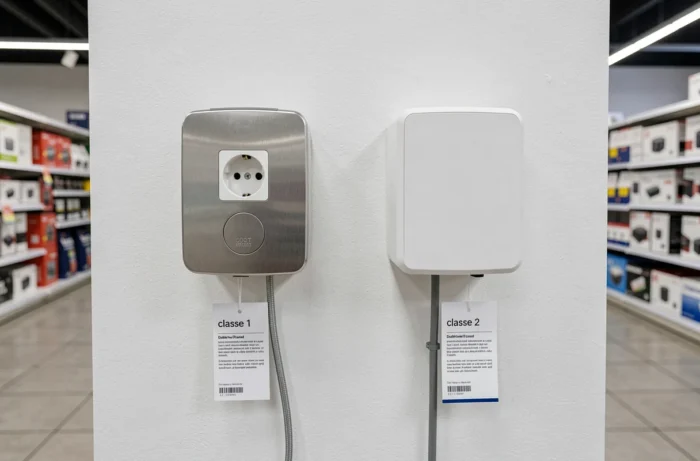
Reinforced insulation versus grounding: reliability in real conditions
The double insulation of a class 2 fixture may seem easier to install, but it imposes strict manufacturing constraints. The LED driver, connection terminals, and the body of the fixture must all comply with precise insulation distances between conductors and accessible parts.
What compactness changes for thermal dissipation
European ecodesign regulations impose efficiency and lifespan thresholds on light sources. For a compact class 2 fixture, integrating the driver into a double-insulated housing complicates thermal dissipation. The available volume is smaller, and heat dissipates less effectively than in a class 1 fixture whose metal parts, connected to the ground, provide more cooling surface area.
Feedback varies on this point among manufacturers, but it is observed that class 2 fixtures with non-replaceable integrated drivers sometimes age faster in recessed installations where ventilation is low.
Component replacement and durability
A class 1 fixture with a separate driver allows for changing the driver without replacing the entire fixture. In a compact class 2 fixture, the driver is often molded or encapsulated in the insulating housing. When it fails, the whole unit is discarded. European repairability requirements are pushing manufacturers to reconsider this design, but most entry-level class 2 products remain monolithic blocks.
Protection class and damp areas: bathroom and outdoors
The insulation class (1 or 2) does not replace the IP rating. A class 2 fixture without an appropriate IP rating has no place above a shower. The two concepts are combined.
In the bathroom, the NF C 15-100 standard defines volumes. In volume 1 (above the bathtub or shower tray), only fixtures powered by SELV are allowed. In volume 2, a class 2 fixture with a minimum appropriate IP rating is suitable. Here are the criteria to check before choosing:
- The installation volume (0, 1, or 2) determines the maximum voltage and the required IP rating, not the insulation class alone.
- A class 2 fixture in volume 2 must have at least an IP rating suitable for water projections, in accordance with the current standard.
- A class 1 fixture can be used outside of volumes if the earth is available and properly connected to the panel.
Outside, the logic is the same. A class 2 garden fixture with a good IP rating avoids the corrosion problem on the earth wire, common in damp soils where earth connections degrade.

Choosing between class 1 and class 2 based on existing installation
The choice is not made based on aesthetic preference. It depends on the actual state of the wiring and the installation location. Here is a concrete decision grid:
- Earth wire present and connected to the panel: class 1 or class 2, both are suitable. Class 1 offers redundant safety (insulation plus ground).
- Earth wire absent or questionable: prefer a class 2 fixture to ensure compliance without rewiring the entire line.
- Damp environment (bathroom, outdoors, basement): first check the volume and required IP, then choose the compatible class.
- Fixture recessed in a false ceiling with little ventilation: a class 1 model with a remote driver facilitates maintenance and thermal dissipation.
The trap of identical replacement
Replacing an old class 1 fixture with a class 2 model seems harmless. You simply remove the earth wire from the connection. In practice, it is necessary to check that the new fixture is indeed certified class 2 and not just a device from which the earth terminal has been removed. The double square marking on the fixture is the only reliable guarantee.
Conversely, switching from class 2 to class 1 requires ensuring that the earth wire actually reaches the connection point. An earth wire present in the conduit but not connected to the panel does not provide any protection.
The choice between class 1 and class 2 is not a question of quality or range. It is a technical constraint dictated by the installation. A well-designed class 2 fixture protects as effectively as a class 1, through a different mechanism. Checking the existing wiring before ordering avoids ending up with an unusable fixture on the installation day.