The letter to the bride is neither a ceremony speech nor a note slipped into a guestbook. It is a text read in private, often before or during the preparations, by someone close who chooses to articulate specific words about a specific bond. The difficulty rarely lies in the lack of emotion, but in the ability to translate this bond into phrases that resemble no other.
The trap of generic text in a letter to the bride
Most templates available online offer interchangeable formulations. They contain the same wishes for happiness, the same references to the joy of the big day, the same phrases about love and union. The result sounds just enough not to offend anyone, but not enough to truly touch.
The problem does not stem from the content. It comes from the lack of detail. A phrase like “I wish you all the happiness in the world” could appear in any greeting card. In contrast, recalling a car ride one November evening when the bride shared her doubts about her life, and then linking that memory to the person she has become, creates an effect that no one else can replicate.
Knowing how to personalize a letter to the bride begins with accepting that the text does not need to be literary. It needs to be irreplaceable.
Letter to the bride: choosing a guiding thread rather than a list of memories
A common mistake is to pile up anecdotes. Three childhood memories, two references to vacations, a mention of the couple. All of this creates an emotional inventory, not a message. A single guiding thread gives more strength than a dozen scattered anecdotes.
This thread can take several forms:
- A quality of the bride observed in very different contexts (her way of protecting others, her ability to laugh in tense moments, her determination in the face of obstacles)
- An evolution: the person she was at one point and the person she has become, seen by someone who witnessed this transformation
- An object or a recurring place in your relationship (a café, a song, a repeated gesture) that serves as an anchor point for the text
The guiding thread allows the reader to feel a progression. The letter tells a story; it does not merely assert an emotion.
The right level of detail
A vague memory (“we had good times together”) leaves no impression. A memory that is too precise without connection to the message (“you were wearing a blue sweater that day”) distracts. The useful detail is the one that reveals a character trait or a turning point.
For example, mentioning the exact moment when the bride made a difficult decision, briefly describing the scene and what you felt watching her act, gives the text a density that generic formulations cannot achieve.
Tone and register: adapting the letter to the real relationship
A mother does not write like a childhood friend. A sister does not write like a colleague who has become close. The tone of the letter should reflect how you actually speak to each other, not a solemn version of your relationship.
If you call each other by nicknames, use them. If your bond is based on humor, do not shift to an entirely serious tone just because it’s a wedding. A letter that sounds like the person writing it resonates more than a well-crafted but impersonal text.
Feedback varies on this point: some brides prefer a short and direct message, while others are touched by a longer, more structured text. The ideal length depends on your relationship and what you have to say, not on a standard format.
Managing emotion without overwhelming the text
A common pitfall is to multiply superlatives and declarations of love. “You are the most beautiful,” “I am so proud,” “you deserve the best.” These phrases, taken in isolation, are sincere. Accumulated, they lose their weight.
A single phrase of raw emotion placed in the right spot is worth more than ten declarations scattered throughout the text. Save your strongest phrase for the end, or for the moment when you shift tone in the letter.
Support and presentation of the letter for the wedding day
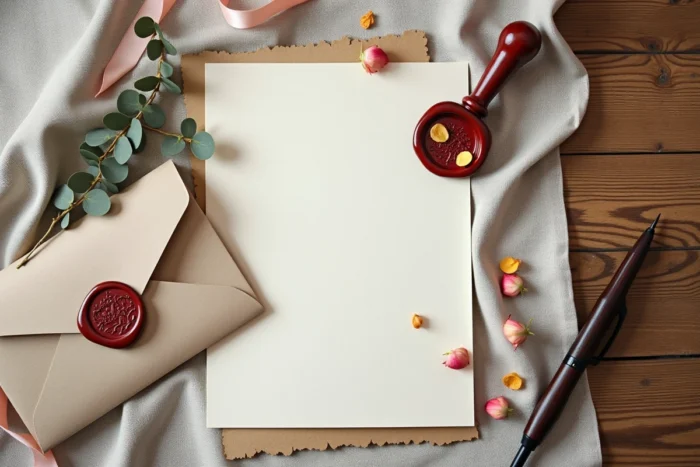
For several seasons, wedding planners have integrated personal messages into the overall scenography of the wedding. The letter to the bride is no longer limited to a folded sheet in an envelope. It can become an element of the artistic direction of the day, on par with flowers or lighting.
Some concrete ideas:
- A paper chosen for its texture and weight, consistent with the wedding color palette
- Handwritten calligraphy (yours, even imperfect, is better than a printed font)
- A planned moment for the delivery: during the morning preparations, slipped into the dress box, or read aloud in a small circle
The physical support extends the message well beyond the day. A letter on beautiful paper can be kept. A message sent by email or copied from a template gets lost in the flow.
The right time to write
Do not write the day before. Urgency pushes towards ready-made formulations. Start by jotting down, several weeks in advance, the memories and ideas that come to you spontaneously. Let it rest. Return to the text after a few days to check that each sentence adds something that the previous one did not say.
Cold proofreading reveals empty passages, repetitions, and phrases you have already read elsewhere. If a sentence could appear in anyone’s letter to any bride, delete it.
The letter that remains in a memory box for years is never the one that said everything. It is the one that said one true thing, in the right way, at the right time.