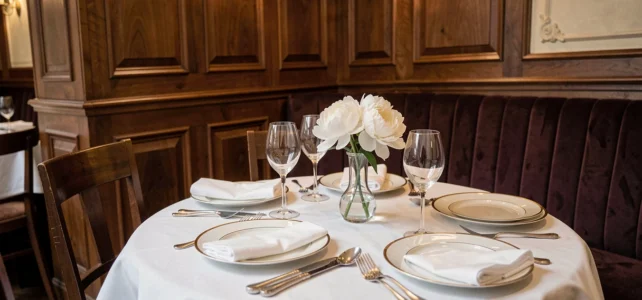
Creating a grand occasion menu in Paris is not just about lining up prestigious dishes. Choosing a refined menu for a Parisian celebration involves precise trade-offs between meal structure, product seasonality, beverage pairings, and logistical constraints specific to high-end events.
Tasting Menu Sequencing for Grand Occasions in Paris
A successful celebration menu relies on its culinary drama. We recommend a sequencing of five to seven courses for a seated dinner, compared to three to four for lunch. A common mistake is overloading the course with overly generous portions at the beginning of the meal, which overwhelms the tasting progression.
The amuse-bouche plays a often underestimated technical role. It calibrates the palate, announces the chef’s aromatic profile, and sets the service rhythm. A failed amuse-bouche, whether too salty or too complex, disrupts the entire sequence.
Between the starter and the main course, the intermediary (revisited trou normand, tangy sorbet, clear broth) is not merely an ornament. It ensures the transition between the iodized or vegetable notes of the starter and the power of the protein dish. Parisian tables that eliminate this step for economic reasons lose coherence in tasting.
To explore a refined menu in Paris on Idées Gâteaux, this sequencing logic is reflected in the formulas designed for exceptional receptions around the Rivoli area.
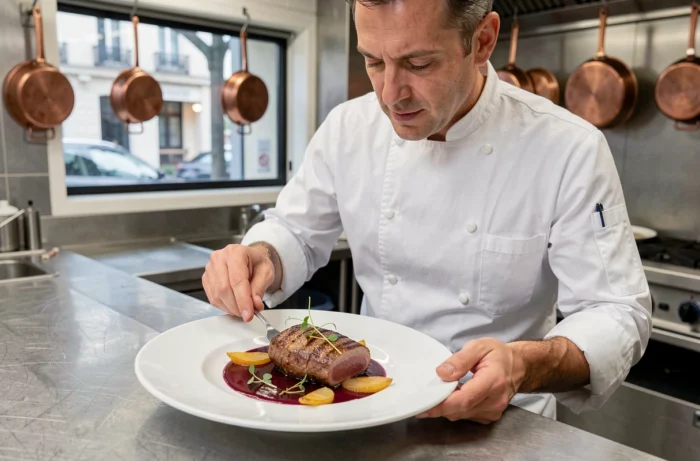
Plant-Based Menu and Non-Alcoholic Pairings: The New Codes of Exceptional Menus
Fully vegetarian or vegan tasting menus have taken center stage in the Parisian offering, including at starred restaurants. It is no longer a concession made for a few guests, but a full-fledged creative direction. For a grand occasion, offering a complete plant-based course has become a marker of prestige, not a default option.
In practical terms, this requires a much more demanding approach to textures and cooking than a classic menu. A root vegetable roasted at low temperature, glazed, then plated with an emulsion of roasted seeds demands as much technique as a crusted fish. The material cost may be lower, but the preparation time is often greater.
Non-Alcoholic Pairings Designed as a True Journey
High-end non-alcoholic alternatives (kombuchas, fermented infusions, botanical decoctions, tasting mocktails) have become a structuring trend in major Parisian establishments and event catering. These beverages are now conceived as a pairing journey on par with wine, integrated into tasting menus for grand occasions.
We observe that tables offering a dual pairing (wine and non-alcoholic) in parallel achieve significantly higher satisfaction from their guests during private receptions. The additional cost remains moderate compared to an ambitious wine list.
Criteria for Selecting a Gastronomic Reception Venue in Paris
The setting is as important as the plate for an exceptional dinner. Not all Parisian restaurants are suitable for privatization, and culinary quality alone does not guarantee the success of an event.
- Partial or total privatization capacity: a separate room with dedicated service avoids sound interferences and allows for personalized scenography (flowers, lighting, music)
- Chef’s flexibility on the menu: establishments rigid about their standard tasting menu complicate the consideration of dietary restrictions, allergies, and cultural preferences of the group
- Documented allergen management: French regulations require precise labeling, but for a private event, the level of demand far exceeds the legal minimum, with ingredient-by-ingredient traceability communicated in advance
- Accessibility and logistics: proximity to transport, valet parking options, accessibility for people with reduced mobility, and sufficiently flexible service hours to avoid rushing the end of the evening
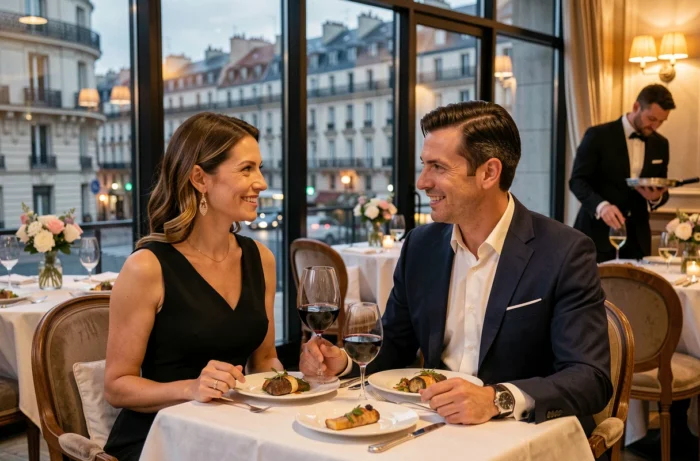
Seasonality and Sourcing: What Distinguishes a Refined Menu from a Standardized One
A grand occasion menu that features asparagus in November or game in April reveals an industrial approach. Strict seasonality is the first filter of credibility for a Parisian gastronomic table. Chefs who work in short supply chains with identified producers adapt their menu weekly, sometimes daily.
For an event planned several weeks in advance, this constraint means validating the menu no later than ten days before the date. A serious chef will refuse to lock in a dish two months ahead, as the availability of a specific product (shellfish, wild mushrooms, local herbs) cannot be guaranteed that far out.
Fish and Shellfish: Markers of Parisian Festive Cuisine
Seafood occupies a central place in exceptional Parisian menus. Their freshness demands an impeccable logistics chain, with daily arrivals from Breton or Norman fish markets. A line-caught sea bass in a salt crust or a Breton lobster served on the same day as it was caught transforms a celebratory dinner into a sensory experience that is hard to replicate at home.
The locavore trend reinforces this territorial anchoring. Several Parisian addresses claim exclusively French sourcing, incorporating vegetables grown in Île-de-France and cheeses aged within a limited radius around the capital.
Dessert and Pastry: The Final Signature of the Celebration Menu
The dessert remains the last taste impression, the one that solidifies the memory of the evening. In the context of a grand occasion, the pastry must combine visual spectacle and aromatic precision. A dessert that is too sweet after a five-course tasting menu fatigues the palate instead of concluding it.
We recommend desserts with a fruity or dairy focus, with a marked acidity that rekindles the appetite and naturally accompanies the transition to coffee or a digestif. A light pre-dessert before the main dessert extends the drama of the meal without weighing down the guest.
Tiered cakes and ceremonial cakes remain relevant for weddings or anniversaries, provided their architecture does not sacrifice taste. A spectacular assembly can sometimes mask an industrial sponge cake or poorly balanced cream. It is better to have a simple piece, made on the same day, than an impressive construction prepared the day before.
The choice of a refined menu for a grand occasion in Paris hinges on these technical details that generic recommendation lists do not address. The coherence of sequencing, the rigor of seasonal sourcing, and the quality of beverage pairings, whether alcoholic or not, make the difference between a good dinner and a truly memorable moment.